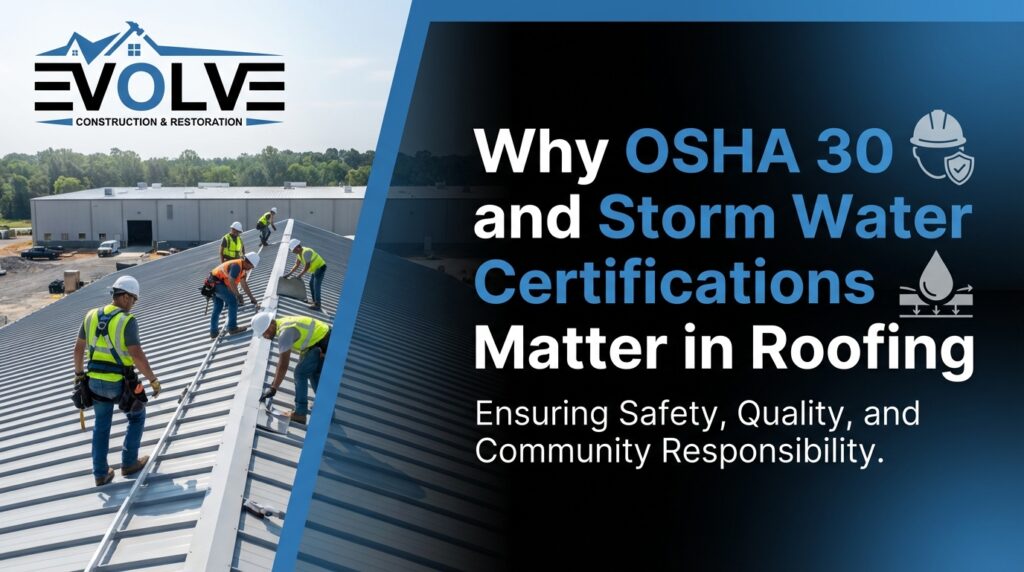
Beyond The Shingles: Why OSHA 30 And Storm Water Certifications Matter
When a major storm hits, your neighborhood is often flooded with more than just rain; it is flooded with “storm chasers.” These fly-by-night contractors often offer the lowest prices and the quickest timelines, but they frequently skip the most critical aspects of professional construction: safety and environmental responsibility. At Evolve Construction, we believe that a roof is only as good as the standards held by the people installing it. This is why we go beyond the industry minimums to secure advanced certifications like OSHA 30 and Storm Water Risk Management (SRM).
Why do these technical certifications matter to a homeowner or a commercial property manager? Simply put, they are the line of defense between a successful renovation and a legal or environmental nightmare. OSHA 30 and Storm Water certifications are not just pieces of paper; they represent a deep commitment to protecting your property, the people working on it, and the local ecosystem from the hazards inherent in construction. In this guide, we will explore why these certifications are the hallmark of a truly professional contractor.
Featured Snippet Answer:
OSHA 30 and Storm Water certifications matter because they ensure a contractor follows rigorous safety protocols to prevent accidents and implements sediment controls to stop toxic construction runoff. These certifications protect homeowners from liability, safeguard local water quality, and guarantee that a high level of professional discipline is applied to every shingle and structural component of the project.
1. Beyond the Shingles—Redefining Roofing Excellence
Roofing is often viewed as a simple commodity—shingles, nails, and labor. However, the reality of modern construction is far more complex. A roofing project is a major industrial undertaking that involves high-risk heights, heavy machinery, and the displacement of chemical-heavy materials. When a contractor ignores the broader context of their work, the homeowner is the one who ultimately pays the price through property damage, poor craftsmanship, or even legal complications.
Redefining roofing excellence means moving away from the “fast and cheap” mentality. It requires a holistic view of the job site where the safety of the crew and the health of the surrounding environment are prioritized alongside the aesthetic of the finished roof. At Evolve Construction, we lean into our certifications as a way to differentiate our services from those who lack the discipline to follow federal and local regulations. By focusing on the “how” and “why” of our process, we ensure a superior result for the “what.”
These certifications also serve as a benchmark for professionalism. In an industry where barriers to entry are often low, advanced training signals a company that is invested in its future and its community. It shows that we aren’t just here for the next storm; we are here to build a better tomorrow through sustainable and safe practices that stand the test of time.
2. OSHA 30: Building a Foundation of Safety Beyond the Minimum Requirements
Most people have heard of OSHA, the Occupational Safety and Health Administration. However, there is a significant difference between the standard OSHA 10-hour training and the comprehensive OSHA 30-hour Construction Training. While the 10-hour course is designed for entry-level workers to recognize basic hazards, the OSHA 30-hour course is specifically designed for supervisors, project managers, and leads. It provides a deeper dive into hazard recognition, avoidance, and prevention.
Understanding the OSHA Focus Four Hazards
A primary component of OSHA 30 training is mastering the “Focus Four” hazards, which account for the vast majority of fatalities in the construction industry. These include Falls, Struck-by incidents, Caught-in or Between accidents, and Electrocution. By training our leads to identify these risks before they happen, we create a workplace where accidents are not just managed but systematically eliminated. For a homeowner, this means your property never becomes a crime scene or a site of tragedy due to preventable negligence.
Why the 30-Hour Standard Trumps the Basic Card
The OSHA 30 curriculum covers specific topics that the 10-hour course skips, such as detailed scaffolding requirements, stairways and ladders, and concrete/masonry safety. More importantly, it emphasizes safety leadership. A supervisor with an OSHA 30 card is trained to manage a safety culture, ensuring that every sub-contractor and laborer on your roof is following the highest possible safety standards. This level of oversight is rarely found among uncertified crews who may cut corners when no one is looking.
3. Storm Water Certification: Mastering the Flow of Environmental Responsibility
Construction is inherently messy, and roofing is no exception. Between the removal of old asphalt shingles—which are petroleum-based—and the use of adhesives, sealants, and primers, a roofing site is full of potential pollutants. Storm Water Risk Management (SRM) training teaches contractors how to prevent these pollutants from leaving the job site and entering the local water supply through storm drains.
The Environmental Impact of Construction Runoff
When it rains during a construction project, the water picks up sediment, debris, and toxic chemicals. This “first flush” carries these materials into the nearest waterway, where they can devastate aquatic ecosystems and contaminate local drinking water. Without proper sediment control and runoff management, a simple roof replacement can inadvertently poison a neighborhood pond or contribute to larger-scale environmental degradation. SRM certification ensures that we use silt fences, gutter protection, and proper waste storage to keep your site clean.
Implementing a Stormwater Pollution Prevention Plan (SWPPP)
Certified professionals know how to develop and implement a Stormwater Pollution Prevention Plan (SWPPP). This is more than just a list of rules; it is a strategic map of how water will move across your property during construction. We identify the “outfalls”—the places where water leaves your lot—and install barriers to filter out contaminants. By managing the flow of water, we protect your landscaping from erosion and ensure that Evolve Construction leaves your property as clean (or cleaner) than we found it.
4. The Hidden ROI: How Certifications Protect Your Bottom Line
Choosing a certified contractor might seem like a premium choice, but it is actually the most cost-effective decision a property owner can make. The Return on Investment (ROI) of hiring an OSHA 30 and SRM-certified team comes from the “hidden” costs that you avoid. Uncertified contractors often pass their risks onto the homeowner, even if it isn’t immediately apparent in the initial quote.
Reducing Workers’ Compensation and Insurance Premiums
Contractors who prioritize safety through OSHA 30 training have fewer accidents. Fewer accidents lead to lower workers’ compensation claims and reduced insurance premiums. These savings allow reputable contractors like Evolve Construction to invest in better materials and higher-quality labor without ballooning the price for the client. Furthermore, if a worker is injured on your property and the contractor is under-insured or negligent, you could potentially face legal liability or claims against your own homeowner’s insurance.
Avoiding the High Cost of Regulatory Non-Compliance
The EPA and local municipalities are increasingly aggressive about enforcing storm water regulations. Fines for improper sediment control can reach thousands of dollars per day. In many jurisdictions, the property owner is held jointly responsible for these environmental violations. By hiring a contractor with SRM certification, you are purchasing an insurance policy against regulatory fines and the bureaucratic headache of city inspections and “stop-work” orders that can delay your project for weeks.
5. Why Clients Care: Turning Technical Compliance into Peace of Mind
For our high-end residential and commercial clients, peace of mind is the ultimate luxury. When you hire Evolve, you aren’t just buying a roof; you are buying the confidence that the job will be done correctly, safely, and without drama. Technical compliance is the engine that drives this peace of mind. While other contractors might “wing it,” we follow a proven framework that leaves nothing to chance.
Protecting Your Landscaping and Local Waterways
One of the most common complaints after a roofing job is the damage to the yard. Heavy equipment, falling debris, and chemical spills can kill expensive grass and shrubs. Our SRM training includes protocols for protecting the ground. We don’t just dump shingles; we manage the site layout to minimize the footprint of the construction. This level of care extends to your neighbors as well, ensuring that no runoff or debris migrates onto their property, which helps maintain good community relations during the build.
The Correlation Between Safety and Long-Term Roof Performance
There is a direct correlation between the discipline required for safety certifications and the quality of the final product. A crew that is trained to meticulously inspect their safety harnesses and monitor weather conditions for storm water runoff is the same crew that will meticulously install your flashing and seal your vents. Discipline is not a part-time trait. If a contractor is sloppy with safety, they are likely sloppy with their shingle alignment and waterproofing. Professionalism is a unified culture that permeates every nail driven into your roof.
6. The Professionalism Gap: Certified Crews vs. “Self-Taught” Standards
In the roofing world, much of the knowledge is passed down through “on-the-job” training. While experience is valuable, “self-taught” crews often inherit bad habits and outdated methods. The “Professionalism Gap” occurs when these crews encounter modern building codes or complex environmental regulations that they aren’t equipped to handle. Certification closes this gap by introducing standardized, evidence-based practices that exceed old-school traditions.
Attracting Top-Tier Talent Through Safety Culture
The construction industry is currently facing a labor shortage. The best, most skilled roofers want to work for companies that value their lives and provide them with the training they need to succeed. By maintaining an OSHA 30-certified culture, Evolve Construction attracts and retains high-tier talent. This means the people on your roof are career professionals, not temporary laborers who were picked up for a single season. A stable, well-trained crew leads to consistent results and fewer mistakes.
The Discipline of Certification and Its Impact on Craftsmanship
Certification requires a commitment to lifelong learning. It forces a contractor to stay current with the latest materials, such as solar shingles and advanced underlayments. This mindset of continuous improvement translates directly into better craftsmanship. We don’t do things “the way we’ve always done them” if there is a safer, more efficient, or more durable way to do it now. Our certifications are a promise that we are bringing the most modern and effective techniques to your property.
7. The Intersection of Safety and Sustainability: A Holistic Approach
We often think of safety and environmentalism as two separate goals, but in professional construction, they are inextricably linked. A safe site is inherently an organized site. An organized site is one where materials are stored correctly, waste is managed properly, and hazards are neutralized. When a site is organized, the risk of chemical spills and loose debris entering the ecosystem is naturally reduced. This is the intersection of safety and sustainability.
By viewing our projects through this holistic lens, we reduce the total impact of construction. We minimize waste, which reduces the amount of material heading to the landfill. we manage runoff, which protects the soil health of your property. This approach isn’t just about “doing the right thing”—it’s about creating a more efficient and effective workflow that benefits everyone involved. Sustainability in roofing means building a system that protects the home for 30 years while ensuring the surrounding environment remains healthy for 100.
8. Future-Proofing Your Property: Climate Resilience and Stricter Enforcement
As weather patterns change, we are seeing more frequent and intense storm events. This “new normal” means that standard roofing practices are no longer enough. Homes and businesses need more resilient structures, and construction sites need more robust storm water controls. A contractor who is certified in Storm Water Risk Management is better prepared to handle these intense weather events, ensuring that a sudden downpour doesn’t turn your renovation into a catastrophe.
Furthermore, federal and state agencies are continuously updating their safety and environmental standards. What was acceptable ten years ago may now be a violation. By choosing a contractor like Evolve Construction that prioritizes ongoing education and advanced certification, you are future-proofing your project. You are ensuring that your roof is built to the standards of tomorrow, not the regulations of yesterday. We stay ahead of the curve so you never have to worry about the changing legal or environmental landscape.
Conclusion: The Future of Roofing is Certified, Safe, and Sustainable
When you look up at your new roof, you should see more than just shingles. You should see the result of hundreds of hours of training, a commitment to the safety of every worker, and a deep respect for the environment that surrounds your property. OSHA 30 and Storm Water certifications are the tools we use to build a better tomorrow for our clients and our community.
Don’t settle for “good enough.” In the wake of a storm, choose a partner that stands for excellence and transparency. Choose a contractor that understands that protecting your home means protecting everything around it, too. At Evolve Construction, we are proud to lead the industry in safety and environmental responsibility because we know that quality construction is about more than just what happens on the roof—it’s about the legacy we leave behind in the community.
Ready to Get Started?
Our honest, friendly, and reputable professionals help homeowners and businesses maximize the value of their property and stand together with them to rebuild for a better tomorrow, especially after challenging storm events. Whether you need a simple repair or a full-scale restoration, we bring certified expertise to every job.