Choosing the right membrane for a commercial flat roof is one of the most significant financial decisions a building owner or facility manager will ever make. It is not merely about keeping the rain out; it is about energy efficiency, long-term asset protection, and operational security. At Evolve Construction, we understand that trust is the foundation of every project. This is why we address the growing industry concerns regarding forged signatures and unauthorized digital check endorsements with a state-of-the-art security approach. By utilizing verified, trackable digital platforms like DocuSign, we create an unalterable paper trail that guarantees homeowners and commercial clients retain absolute control over their financial and legal agreements. This commitment to transparency ensures that your investment in a TPO or EPDM roof is protected from the first signature to the final inspection.
1. Introduction: The High-Stakes Decision of Commercial Flat Roofing
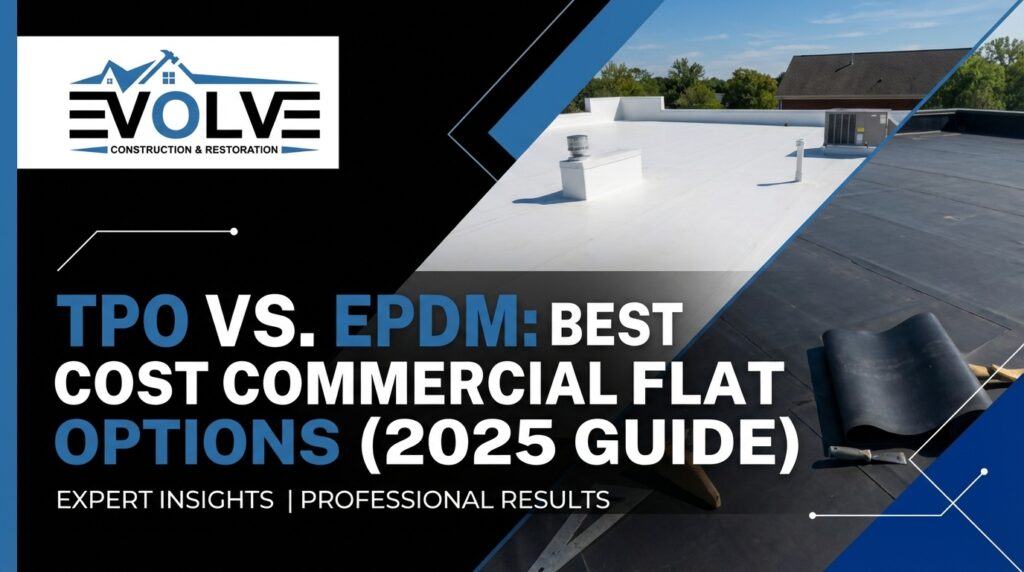
Commercial roofing represents a massive capital expenditure that can either safeguard your business or become a recurring liability. When evaluating flat roof options, the debate almost always centers on two dominant materials: Thermoplastic Polyolefin (TPO) and Ethylene Propylene Diene Monomer (EPDM). Both materials have dominated the market for decades, yet they offer vastly different benefits depending on your building’s location, use, and long-term goals. Making the wrong choice can lead to premature failure, skyrocketing cooling costs, or frequent leaks that disrupt your operations.
In today’s market, the decision is further complicated by shifting environmental regulations and the increasing frequency of extreme weather events. Property owners must weigh the initial installation costs against the total cost of ownership over 20 to 30 years. At Evolve Construction, we believe that an educated client is our best partner. By understanding the nuances of material composition, seam integrity, and climate suitability, you can move from a place of uncertainty to a position of strategic asset management.
Beyond the physical materials, the security of your roofing contract is paramount. We have seen the terrifying reports of consumer complaints regarding forged signatures on letters of representation in the roofing industry. To combat this, we leverage digital platforms as a state-of-the-art security measure. These systems provide timestamped, IP-verified records of every signature, ensuring that you are always in the driver’s seat. Whether you choose TPO or EPDM, you deserve the peace of mind that your contractor is as committed to legal integrity as they are to structural integrity.
The Evolution of the ‘Cool Roof’ vs. ‘Rubber Roof’
Historically, EPDM was the unchallenged king of flat roofing, offering a reliable, rubber-like shield against the elements. However, the rise of the “cool roof” movement in the 1990s brought TPO into the mainstream. TPO’s white, reflective surface changed the math for buildings in southern climates, promising significant reductions in HVAC loads. Today, the choice isn’t just about black vs. white; it’s about which technology aligns with your facility’s specific stressors, from chemical exposure to heavy foot traffic.
Why Your Roofing Choice Impacts Your Bottom Line
A roof is more than a lid on a box; it is an active component of your building’s thermal envelope. Choosing EPDM in a hot climate could lead to thousands of dollars in wasted electricity, while choosing a low-quality TPO in a freeze-thaw region could result in premature membrane cracking. This guide will dissect every technical detail to ensure your next commercial roof is an asset, not an expense.
2. EPDM Deep Dive: The ‘Rubber Roof’ Legacy (Composition & Performance)
Ethylene Propylene Diene Monomer, commonly known as EPDM, is a synthetic rubber membrane that has been used in the commercial roofing industry for over 60 years. Its longevity is legendary, with many systems installed in the 1970s and 80s still performing today. The material is primarily composed of two main ingredients derived from oil and natural gas, which are then cross-linked to create a “thermoset” material. This means that once the rubber is cured, its molecular structure is set and cannot be reshaped by heat.
One of the most distinct features of EPDM is its inclusion of carbon black. This additive acts as a stabilizer, absorbing UV radiation and converting it into heat, which prevents the sun from breaking down the polymer chains. This is why most EPDM roofs are black, though white reinforced versions do exist. The inherent flexibility of EPDM is another major advantage; it can expand and contract up to 300% without losing its structural integrity, making it incredibly resilient against the natural shifting of large commercial structures.
EPDM is available in several thicknesses, typically ranging from 45 mil (about the thickness of a dime) to 90 mil. For commercial applications, we generally recommend a minimum of 60 mil to ensure adequate puncture resistance and longevity. Because it is a thermoset material, it does not become brittle in extreme cold, which has cemented its reputation as the premier choice for northern climates where winters are harsh and long.
Thermoset Advantage: Resilience Under Pressure
The chemical stability of EPDM is its greatest asset. Unlike thermoplastic materials that can soften when exposed to high heat, EPDM remains stable across a wide temperature spectrum. This stability makes it less prone to the “shattering” effects that can plague older, low-quality TPO membranes that have lost their plasticizers over time. When you invest in a thick EPDM membrane, you are investing in a decades-long track record of proven performance.
UV Resistance and Carbon Black
While the black color of EPDM can be a drawback in terms of heat absorption, it is also the secret to its UV resistance. The carbon black allows the membrane to withstand intense solar radiation for decades without the surface chalking or eroding. In regions where cooling costs are less of a concern than heating costs, the heat-absorptive properties of black EPDM can actually provide a “winter heating benefit,” helping to melt snow and ice faster and reducing the load on heating systems.
3. TPO Deep Dive: The Modern ‘Cool Roof’ Standard (Evolution & Technology)
Thermoplastic Polyolefin (TPO) is the fastest-growing segment of the commercial roofing industry. Unlike EPDM, TPO is a “thermoplastic” material, meaning it can be melted and reshaped multiple times. It is composed of a blend of polypropylene and ethylene-propylene rubber, which is usually reinforced with a polyester scrim (a fabric mesh) to provide dimensional stability and tear strength. This combination creates a membrane that is both flexible and exceptionally tough.
TPO gained massive popularity due to its naturally reflective white surface. According to the Cool Roof Rating Council, white TPO membranes can reflect up to 80% or more of solar radiation. This high albedo effect keeps the roof surface significantly cooler than black EPDM, which can reach temperatures of 170°F on a summer day. By keeping the roof cool, TPO drastically reduces the amount of heat transferred into the building, leading to lower energy bills and reduced wear and tear on HVAC equipment.
Modern TPO formulations have come a long way since their introduction in the 1990s. Early versions struggled with heat aging and UV degradation, but today’s high-tier TPO products include advanced stabilizers that allow them to withstand extreme environments. TPO is typically available in 45, 60, and 80 mil thicknesses. The thicker the membrane, the more weathering protection and puncture resistance it provides, which is critical for roofs that house heavy equipment or require frequent maintenance access.
The Multi-Layered Anatomy of TPO
A TPO membrane consists of three layers: a TPO-based top ply, a polyester-reinforced center scrim, and a TPO-based bottom ply. The top ply is where the UV inhibitors and fire retardants are concentrated, while the scrim provides the physical strength needed to resist wind uplift and physical tearing. This layered approach allows manufacturers to optimize the membrane for specific performance characteristics, such as extra-smooth surfaces that resist dirt pick-up and maintain reflectivity longer.
Energy Efficiency and LEED Certification
TPO is the “go-to” choice for buildings seeking LEED certification or compliance with strict local energy codes, such as California’s Title 24. By significantly lowering the “urban heat island effect,” TPO roofs contribute to a cooler local environment. For property managers looking to maximize the ROI of their facility, the energy savings generated by a TPO roof can often pay for the price difference between it and a less reflective system within just a few years.
4. The Seam Showdown: Heat-Welded vs. Adhesive Seams (Which Fails First?)
The seams are the most vulnerable part of any flat roof. Statistics show that the vast majority of commercial roof leaks occur at the seams or around penetrations (like vents and pipes), rather than through the field of the membrane itself. This is where the fundamental difference between TPO and EPDM becomes most apparent. TPO utilizes heat-welded seams, while EPDM typically relies on adhesive-based seam tape.
In a TPO installation, a robotic hot-air welder is used to fuse the overlapping sheets together at temperatures reaching 800°F to 1,000°F. This process creates a physical, monolithic bond where the two sheets essentially become one. The resulting weld is often stronger than the membrane itself. Because there are no adhesives to break down over time, heat-welded seams are highly resistant to moisture, ponding water, and biological growth. This makes TPO an excellent choice for roofs with complex geometries or numerous penetrations.
EPDM seams, on the other hand, are joined using a high-strength seam tape and a primer. While modern EPDM tapes are lightyears ahead of the liquid adhesives used in the past, they are still a “chemical” bond rather than a physical fuse. Over time, the adhesive can be susceptible to degradation from standing water or extreme heat. While an EPDM roof can last 30+ years, the seams may require maintenance or “stripping in” (adding a new layer of tape) around the 15-to-20-year mark. For this reason, EPDM is often preferred in climates where the material isn’t subjected to the blistering heat that can accelerate adhesive failure.
Why Weld Consistency Matters
The success of a TPO roof depends heavily on the skill of the installer and the calibration of the welding equipment. If the welder moves too fast or the temperature is too low, a “cold weld” can occur, which looks solid but will peel apart under stress. At Evolve Construction, our technicians perform daily “peel tests” at the start of every shift to ensure the weld is perfect. This level of precision is why we can confidently offer long-term warranties on our TPO installations.
The Tape and Primer Process
Installing EPDM seams requires meticulous surface preparation. Any dust, moisture, or oil on the membrane can prevent the primer from bonding correctly. This makes EPDM more sensitive to weather conditions during installation. If it rains or is too humid, the seam integrity can be compromised. However, once properly bonded in the right conditions, EPDM tape is remarkably durable and provides the necessary flexibility for the roof to move as the building settles.
5. Cost Analysis 2025: Initial CapEx vs. 20-Year OpEx (Energy Savings Math)
When comparing costs, building owners must look beyond the initial bid. In 2025, the initial Capital Expenditure (CapEx) for EPDM and TPO is often comparable, though TPO can be slightly more expensive due to the specialized equipment and labor required for welding. Generally, a fully adhered 60-mil TPO system may cost between $8.00 and $14.00 per square foot, while a similar EPDM system might range from $7.00 to $12.00, depending on the complexity of the roof and local labor rates.
However, the real story is found in the Operating Expenditure (OpEx). In southern climates, a white TPO roof can reduce peak cooling demands by 10% to 15%. Over a 20-year lifespan, these energy savings can amount to tens of thousands of dollars, effectively reducing the “net cost” of the roof. Furthermore, many utility companies offer rebates for installing reflective “cool roofs,” which can further offset the initial investment. For a 20,000-square-foot warehouse, these rebates can be substantial.
Conversely, in extreme northern climates, the energy math shifts. A black EPDM roof absorbs heat, which can reduce the heating load during the winter months. This is known as the “heating degree day” factor. In cities like Chicago or Minneapolis, the energy savings from a white roof in the summer may be cancelled out by the increased heating costs in the winter. In these regions, the durability and low maintenance of EPDM often make it the more cost-effective choice over the long haul, even without the reflective benefits.
Maintenance Costs and Lifecycle Value
EPDM typically requires more frequent seam inspections, but the material itself is very easy and inexpensive to repair. A simple puncture in EPDM can be fixed with a primer and a patch. TPO repairs are more complex because as the membrane ages, it loses some of its thermoplasticity, making it harder to weld new material to the old surface. This may require the use of specialized “aged TPO” primers and adhesives later in the roof’s life, which can increase maintenance costs in the final decade of the system’s service.
The Impact of Warranty on ROI
Most major manufacturers, such as Carlisle, Firestone (Holcim), and GAF, offer warranties ranging from 15 to 30 years for both TPO and EPDM. However, the requirements for a 30-year warranty usually involve using a thicker membrane (80 or 90 mil) and specific attachment methods. While a 30-year warranty increases the initial cost, it significantly lowers the “cost per year” of the roof, providing better long-term value for permanent assets.
6. Durability Under Pressure: Punctures, Hail, and Rooftop Foot Traffic
Commercial roofs are often used as platforms for HVAC units, solar arrays, and communication equipment. This leads to frequent foot traffic, which is a major cause of membrane damage. TPO is generally considered to have superior puncture resistance compared to EPDM. The reinforced scrim inside TPO acts like a bulletproof vest, preventing sharp objects from penetrating through the membrane. This makes TPO a better choice for roofs that expect regular maintenance crews or are located in areas prone to light hail.
EPDM, being a non-reinforced rubber (in most standard versions), is softer and more susceptible to punctures from dropped tools or sharp debris. However, EPDM is exceptionally resistant to hail. Because it is highly elastic, it can absorb the impact of large hailstones by stretching and bouncing back, whereas a stiff, aged TPO membrane might crack under the same impact. For buildings in the “Hail Alley” regions of the Midwest, a thick, ballasted EPDM system is often the most durable defense available.
Environmental factors also play a role in durability. TPO is highly resistant to chemical exhaust, making it the preferred choice for manufacturing facilities or restaurants that vent grease and oils onto the roof. EPDM can swell and degrade if it comes into contact with animal fats, petroleum products, or certain industrial chemicals. If your facility has a commercial kitchen, TPO is almost always the safer bet to avoid premature membrane failure around the exhaust fans.
Managing Rooftop Foot Traffic
Regardless of the material chosen, high-traffic areas should always be protected with “walkway pads.” These are thick, textured mats that are welded or adhered to the membrane around HVAC units and roof hatches. Investing in walkway pads is a small upfront cost that can prevent the #1 cause of warranty-voiding leaks: accidental punctures from service technicians. At Evolve Construction, we include a walkway plan in every commercial proposal to ensure your membrane stays intact.
Impact of Standing (Ponding) Water
Flat roofs are rarely perfectly flat; they are designed with a slight slope to move water toward drains. However, “ponding water” (water that remains on the roof for more than 48 hours) is common. TPO’s welded seams are generally more resilient to ponding water than EPDM’s taped seams. Over time, constant submersion can cause EPDM seam tape to soften and lose its grip. If your roof has known drainage issues that cannot be easily corrected, TPO or a fluid-applied coating may be a more reliable option.
7. Climate Context: Regional Recommendations (Northern Freeze-Thaw vs. Southern UV)
Your geographic location is perhaps the single most important factor in the TPO vs. EPDM debate. In the southern United States, where the sun is relentless and cooling degree days far outnumber heating degree days, TPO is the clear winner. The UV resistance and thermal reflectivity of TPO prevent the “baking” effect that can prematurely age EPDM. Furthermore, by keeping the roof assembly cooler, TPO protects the underlying insulation and deck from thermal shock and expansion-contraction stress.
In the North, the choice is more nuanced. EPDM has a long-standing reputation for performing in freeze-thaw cycles. Because it remains flexible down to -40°F, it doesn’t become brittle or crack when the building moves in the dead of winter. Additionally, the black surface helps clear snow faster by absorbing solar heat. This can prevent ice damming and reduce the weight load on the structure during heavy snow years. For these reasons, EPDM remains the “gold standard” for many architects in Canada and the northern US.
However, we are seeing a shift even in northern climates due to new building codes. The 2021 and 2024 International Energy Conservation Code (IECC) updates have increased the R-value requirements for roof insulation. In some cases, using a reflective TPO membrane allows for a slightly lower insulation thickness while still meeting energy compliance, which can save on material costs. It’s essential to consult with a contractor who understands the specific codes in your municipality to ensure your new roof is compliant.
The ‘Thermal Shock’ Factor
Thermal shock occurs when a roof surface temperature drops rapidly, such as during a summer thunderstorm after a hot day. TPO, being more rigid, undergoes more stress during these rapid changes than the highly elastic EPDM. In regions with frequent, violent temperature swings, EPDM’s ability to stretch and contract quickly gives it a slight edge in long-term structural fatigue resistance.
UV Degradation in High-Altitude Regions
In high-altitude areas like Denver or Salt Lake City, UV radiation is significantly more intense. While both membranes are designed for UV resistance, the white surface of TPO reflects a larger portion of this radiation away from the building. However, the high UV levels can also cause lower-quality TPO to “chalk” and erode faster. In these regions, we always recommend a high-performance, 80-mil TPO with enhanced UV stabilizers or a premium EPDM system with a UV-resistant coating.
8. Specialized Commercial Use-Cases: Restaurants, Warehouses, and Industrial Plants
Not all commercial buildings are created equal. A warehouse has very different needs than a hospital or a chemical processing plant. For large-scale warehouses and distribution centers, TPO is often the preferred choice because it can be installed quickly using mechanical attachment methods over vast areas. Its reflectivity also helps maintain a more comfortable working environment for employees inside non-air-conditioned spaces, which can improve safety and productivity.
For restaurants and food processing facilities, TPO is almost mandatory. These buildings often vent animal fats, vegetable oils, and high-temperature steam onto the roof. Standard EPDM will swell and disintegrate when exposed to these fats, leading to catastrophic leaks within just a few years. TPO is naturally resistant to many animal fats and chemicals. For extreme environments, specialized “TPO-XR” or PVC (a similar thermoplastic) might be recommended, but standard TPO is generally sufficient for most restaurant applications.
Industrial plants and laboratories require a different level of scrutiny. If the facility emits chemical vapors, a detailed chemical compatibility chart must be consulted. EPDM is highly resistant to polar solvents (like ketones and alcohols) but fails quickly when exposed to non-polar solvents (like hydrocarbons and oils). TPO has a broad range of resistance but can be sensitive to certain industrial acids. In these cases, Evolve Construction works closely with manufacturer engineers to select the specific membrane formulation that will withstand the facility’s unique chemical footprint.
The Data Center Challenge
Data centers generate an immense amount of internal heat and require massive cooling systems. A white TPO roof is essential for these facilities to minimize the “external heat gain” from the sun, allowing the cooling systems to operate more efficiently. Additionally, because TPO is heat-welded, it provides a more secure, airtight seal, which is critical for maintaining the precise humidity and pressure levels required in server rooms.
Retail and Hospitality Considerations
For retail and hospitality buildings, aesthetics and noise during installation are major factors. A ballasted EPDM roof (where the membrane is held down by large river stones) can be an attractive and quiet option. However, if the building is in a high-wind zone, the ballast can become a projectile risk. In these scenarios, a fully adhered TPO system provides a clean, modern look and superior wind uplift resistance without the weight of stone ballast.
9. Solar-Ready Roofing: Preparing for a Sustainable Commercial Portfolio
With the surge in commercial solar installations, your choice of roofing membrane has never been more important. Solar panels can significantly increase the temperature of the roof surface directly beneath them and add weight and maintenance traffic to the system. TPO is widely considered the superior choice for solar-ready roofing. Its white surface reflects light onto the underside of “bi-facial” solar panels, which can increase energy production by up to 10-15% compared to panels over a dark roof.
Furthermore, the heat-welded seams of TPO are better equipped to handle the stresses of solar racking systems. Many solar mounts can be directly welded to the TPO membrane using specialized “solar boots,” creating a permanent, leak-proof seal. EPDM solar installations usually require penetrating the membrane and using heavy sealants, which can become a maintenance headache over the 25-year life of a solar array. If you are planning to add solar now or in the future, TPO is the clear winner for system compatibility.
Another factor to consider is the “albedo” effect on panel efficiency. Solar panels actually become less efficient as they get hotter. By keeping the entire roof environment cooler, a TPO membrane helps the solar panels operate at a lower temperature, maximizing their electrical output. For commercial property owners looking to maximize their ESG (Environmental, Social, and Governance) scores, the combination of a high-reflectivity TPO roof and a high-efficiency solar array is the gold standard.
Racking and Attachment Methods
There are two main ways to attach solar to a flat roof: ballasted (weighted) and penetrated (fastened to the deck). Ballasted systems are popular because they don’t require holes in the roof, but they are very heavy and can cause the membrane to “creep” or move over time. Penetrated systems are more secure in high winds but carry a higher leak risk. TPO’s ability to accept heat-welded flashing around these penetrations makes it much safer for the latter method.
The Importance of a ‘Roof-First’ Strategy
Never install solar on an old roof. If your EPDM or TPO roof is more than 10 years old, it is usually more cost-effective to replace the roof before installing the solar panels. The cost of removing and re-installing a solar array to fix a roof leak 5 years later is astronomical. Evolve Construction specializes in “solar-ready” roofing, ensuring that the insulation and membrane are optimized to support your renewable energy goals for the next 30 years.
10. Environmental Impact: Lifecycle Analysis and Recycling Realities
As sustainability becomes a core business requirement, many building owners are looking at the environmental footprint of their roofing choices. Both TPO and EPDM are marketed as “recyclable,” but the reality is more complex. TPO, as a thermoplastic, is much easier to recycle at the end of its life. It can be ground up, melted down, and extruded into new roofing products or other plastic goods. Many manufacturers have established “take-back” programs to divert old TPO from landfills.
EPDM is a thermoset rubber, which makes it much harder to recycle. Like a car tire, it cannot be simply melted down. End-of-life EPDM is typically ground up and used as “rubber crumb” for playground surfaces, athletic tracks, or as a fuel source in cement kilns. While this is better than landfilling, it is not a “closed-loop” recycling process like TPO. However, EPDM has a lower “embodied energy” during the manufacturing process compared to TPO, and its extreme longevity (sometimes lasting 40+ years) means it needs to be replaced less often, which is a different form of sustainability.
Another environmental consideration is the impact on the local ecosystem. White TPO roofs reduce the “Urban Heat Island Effect,” which can lower the ambient temperature of an entire city block. This reduces smog formation and decreases the strain on the local power grid. For buildings in dense urban environments like Atlanta, Charlotte, or Houston, the environmental benefits of a TPO roof extend far beyond the building’s walls.
The Carbon Footprint Comparison
A lifecycle assessment (LCA) of roofing materials often shows that the majority of a roof’s carbon footprint comes from the energy used to heat and cool the building over 30 years, rather than the manufacturing of the membrane itself. Because TPO can significantly reduce cooling energy, it often has a lower “lifetime carbon footprint” in warm climates. In cooler climates, EPDM’s longevity and lower manufacturing energy may give it the edge.
LEED v4 and Materials Transparency
Modern green building standards like LEED v4 require “Health Product Declarations” (HPDs) and “Environmental Product Declarations” (EPDs). Both TPO and EPDM manufacturers now provide these documents. TPO is generally free of chlorine and plasticizers, which makes it more attractive for “Red List Free” building projects. EPDM is also safe, but the adhesives and primers used in its installation can contain higher levels of Volatile Organic Compounds (VOCs) unless low-VOC versions are specifically requested.
11. Maintenance Protocols: Keeping Your Warranty Valid for 20+ Years
A commercial roof warranty is not a “set it and forget it” insurance policy; it is a contract that requires the owner to perform regular maintenance. Most manufacturers require at least two inspections per year—typically in the spring and fall—to keep the warranty valid. For TPO roofs, these inspections focus on seam integrity and ensuring the white surface isn’t covered in biological growth or dirt, which can diminish its reflective properties and cause the membrane to overheat.
For EPDM roofs, the focus is on the seams and flashings. Because EPDM is a dark material, it absorbs heat, which can cause the adhesive tape to dry out or “alligator” over time. If the edges of the tape begin to lift, they must be cleaned and re-sealed immediately to prevent water from wicking into the insulation. Additionally, EPDM roofs should be checked for shrinkage. While rare in modern formulations, older EPDM roofs can pull away from the perimeter of the building, requiring the installation of “RUSS” (Reinforced Universal Securement Strip) to stabilize the membrane.
One often overlooked aspect of maintenance is the drainage system. Flat roofs are essentially giant bathtubs if the drains are clogged. Standing water is the #1 enemy of all roofing systems. It accelerates the breakdown of seams, encourages the growth of algae and moss, and can even lead to structural collapse if the weight becomes too great. A simple maintenance protocol of clearing drains and scuppers can add 5 to 10 years to the life of either a TPO or EPDM roof.
The Importance of Professional Inspections
While facility staff can clear drains, a professional roofing contractor like Evolve Construction should perform the detailed inspections. We use infrared thermography to detect moisture trapped beneath the membrane before it causes a visible leak. This “preventative” approach allows us to make small, inexpensive repairs that prevent the need for a premature, million-dollar roof replacement.
Documenting Your Care
Keep a “Roof Log” that includes photos of every inspection, copies of all repair invoices, and a record of everyone who has been on the roof (HVAC techs, window washers, etc.). If you ever need to file a warranty claim, the manufacturer will ask for this documentation. If you cannot prove the roof was maintained, the claim can be denied. Using our digital project management tools, Evolve Construction helps you maintain this digital paper trail for the life of your roof.
12. The Decision Matrix: A 5-Question Framework for Building Owners
Still undecided? Use this 5-question framework to determine which membrane is best for your specific asset. This matrix is based on thousands of successful installations and helps simplify complex technical data into actionable business logic.
- What is your climate zone? If you are in the South (Zones 1-3), choose TPO for the energy savings. If you are in the North (Zones 5-7), EPDM is a safer bet for freeze-thaw durability.
- How long do you plan to own the building? For short-term holds (5-10 years), a 45-mil TPO system provides the best “curb appeal” and energy savings for resale. For long-term assets (20+ years), an 80-mil TPO or 90-mil EPDM will offer the lowest cost-per-year.
- Is there significant rooftop equipment or grease exhaust? If yes, TPO is the clear winner due to its puncture resistance and chemical/grease resistance.
- Are you planning to install solar panels? If yes, TPO is the superior choice for panel efficiency and ease of securement.
- What is your primary concern: CapEx or OpEx? If you need the lowest upfront cost, EPDM with a mechanically attached system is usually the cheapest. If you want the lowest monthly energy bills, an adhered TPO system is the winner.
At Evolve Construction, we don’t believe in a one-size-fits-all approach. We walk the roof with you, analyze your energy bills, and review your building’s structural data to provide a customized recommendation. Whether it’s the 60-year track record of EPDM or the high-tech efficiency of TPO, we stand behind our work with the best warranties and the most transparent digital contracting in the industry.
13. Conclusion: Making the Best Investment for Your Asset
The choice between TPO and EPDM is not a simple “better vs. worse” comparison. It is a strategic decision that involves balancing your building’s geographical location, its operational use, and your financial objectives. TPO offers the modern advantages of energy efficiency, heat-welded seams, and solar compatibility, while EPDM provides a time-tested, flexible, and ultra-durable rubber shield that thrives in cold weather.
Whichever direction you choose, the most critical factor is the integrity of the contractor you hire. A roof is only as good as the hands that install it and the contract that governs it. In an era where consumer fraud is a valid concern, Evolve Construction leads the way with verified digital agreements and a commitment to honest, transparent service. We don’t just build roofs; we build the trust that allows businesses to thrive and communities to rebuild for a better tomorrow.
Ready to Protect Your Commercial Investment?
Our honest, friendly, and reputable professionals help businesses maximize the value of their property with expert TPO and EPDM installations. We stand together with you to build a better tomorrow through transparency and quality craftsmanship.