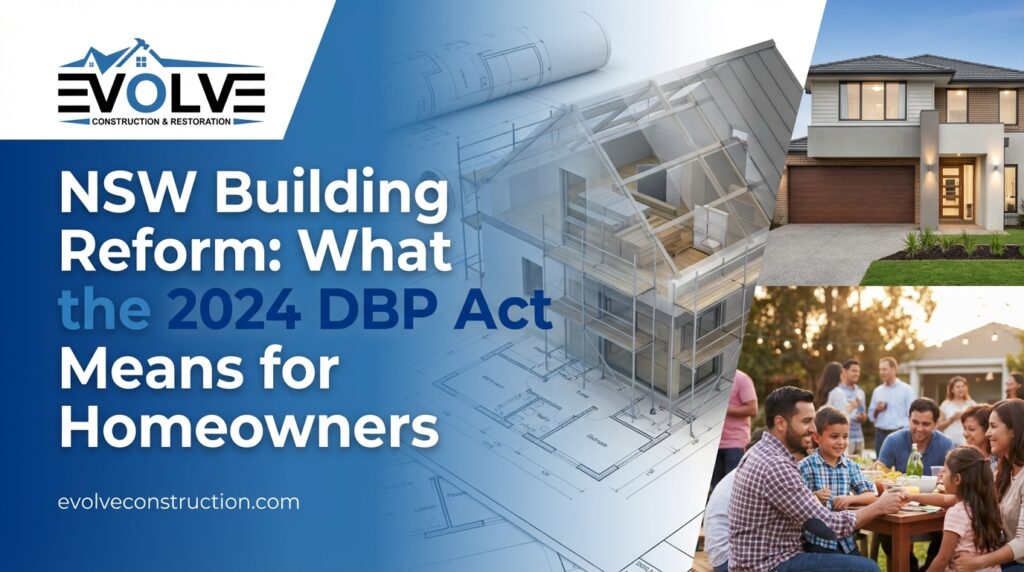
The landscape of residential construction in New South Wales is undergoing its most significant transformation in decades. For years, homeowners and apartment owners faced a volatile market where building quality was often inconsistent, and legal recourse for defects was notoriously difficult to navigate. The Design and Building Practitioners (DBP) Act, initially introduced in 2020, was the state’s answer to high-profile building failures. However, as we move through 2024 and look toward 2025, a new wave of reforms is expanding these protections even further. Understanding these changes isn’t just for lawyers and builders; it is essential for every homeowner planning a renovation, purchasing a new property, or managing an existing asset.
The 2024 NSW Building Reform serves as a comprehensive overhaul designed to restore consumer confidence. By shifting the focus from ‘speed of completion’ to ‘verifiable compliance,’ the New South Wales government is effectively drawing a line in the sand. For homeowners, this means more paperwork and potentially higher upfront costs, but it also provides a level of legal and structural security that was previously non-existent. In this guide, we will break down exactly what the 2024 DBP Act amendments and the upcoming Building Bill mean for your property and your peace of mind.
What does the 2024 NSW Building Reform mean for homeowners? The 2024 reforms expand the DBP Act to include more building types (Class 3 and 9c), introduce a 10-year statutory duty of care for all buildings, and mandate digital compliance declarations. These changes ensure that designers and builders are personally liable for defects, providing homeowners with stronger legal protections and a transparent, unalterable digital record of all construction work.
1. Navigating the 2024 NSW Building Reform Landscape
The current state of construction in NSW is defined by a rigorous push toward accountability. The 2024 reforms are not isolated changes; they are part of a multi-year strategy to professionalize the industry. For the average homeowner, navigating this landscape can feel like walking through a minefield of jargon—Class 2 buildings, regulated designs, and compliance declarations. However, the core objective is simple: to ensure that the person who designs or builds your home is qualified, insured, and held responsible if something goes wrong.
One of the most significant shifts in the 2024 landscape is the move toward a ‘whole-of-life’ view of building safety. Previously, once a building was handed over, the builder’s responsibility often dissipated into a cloud of corporate restructuring. The new reforms make it much harder for practitioners to hide. Through the introduction of the NSW Planning Portal, every major design decision is logged, stamped, and stored. This transparency is the cornerstone of the reform, acting as both a deterrent for poor workmanship and a roadmap for future maintenance.
As we look at the specific updates for this year, homeowners must recognize that the ‘Wild West’ days of uncertified variations and handshake agreements are over. The 2024 DBP Act requirements demand that every ‘regulated element’—from the waterproofing in your bathroom to the structural steel in your roof—must be declared compliant by a registered practitioner. While this adds layers to the project timeline, it serves as an insurance policy for your most valuable asset: your home.
2. Understanding the DBP Act: From the 2020 Foundation to 2024 Amendments
To understand where we are in 2024, we must look back at the catalyst: the Design and Building Practitioners Act 2020. This legislation was born out of the Mascot and Opal Tower crises, which exposed systemic flaws in how multi-residential buildings were certified. Initially, the Act focused almost exclusively on Class 2 buildings (apartments). It required designers to be registered and to issue ‘Design Compliance Declarations’ before any work could begin. This created a paper trail that linked specific practitioners to specific designs.
The 2024 amendments represent the natural evolution of this foundation. The state government realized that the risks found in apartments—such as structural failure and fire safety issues—were equally present in other high-density living environments. Consequently, the scope has widened. We are seeing a transition where the strict standards once reserved for high-rise towers are being applied to a broader range of residential settings. This gradual expansion is intended to stabilize the insurance market and ensure that no homeowner is left behind simply because of their building’s classification.
Key to the 2024 updates is the refinement of practitioner roles. The Act now more clearly defines the responsibilities of engineers, specialist trades, and lead designers. By tightening these definitions, the 2024 amendments close many of the loopholes that practitioners previously used to avoid liability. For homeowners, this means that when you hire a professional, their legal obligations are clearer than ever before, reducing the likelihood of costly legal disputes during the remediation of defects.
3. The Big Picture: How the ‘Building Bill 2024’ is Transforming the DBP Act
Perhaps the most ambitious component of the 2024 reform is the introduction of the consolidated ‘Building Bill.’ For decades, NSW building laws have been scattered across various pieces of legislation, including the Home Building Act 1989, the Architects Act, and the DBP Act itself. The Building Bill 2024 aims to merge these into a single, cohesive framework. This consolidation is a game-changer for homeowners because it simplifies the rules of engagement for every residential project, whether it’s a single-family home or a complex mixed-use development.
This ‘Big Picture’ approach is designed to eliminate the confusion that often arises when different laws apply to different parts of the same project. Under the new Bill, the high standards of the DBP Act will eventually become the baseline for all construction work in NSW. This means that the ‘duty of care’ and ‘compliance declaration’ models will likely extend to Class 1 dwellings (stand-alone houses), ensuring that every homeowner in the state benefits from the same level of consumer protection and professional accountability.
Furthermore, the Building Bill 2024 introduces modern regulatory powers, including the ability for the Building Commissioner to stop work or order rectifications more swiftly. For homeowners, this provides a faster path to resolution than the traditional court system. If a builder is found to be non-compliant mid-project, the regulator can step in before the defect is buried behind drywall or concrete. This proactive enforcement is a major shift from the reactive ‘sue-them-later’ model of the past.
4. Key Changes for Homeowners in 2024-2025 (Insurance, Classes, and Compliance)
The most immediate changes homeowners need to track involve the extension of building classes. As of late 2023 and into 2024, the DBP Act now applies to Class 3 (boarding houses and hostels) and Class 9c (aged care facilities). If you are an investor in these sectors or a family member involved in the management of these properties, the compliance requirements have drastically increased. Every renovation or new build in these classes now requires registered practitioners and formal declarations on the NSW Planning Portal.
Another critical update is the inclusion of ‘vertical transportation’ (elevators and lifts) as a regulated building element. This is a vital safety move, as lift failures are both dangerous and expensive to fix. If your home or complex is installing or replacing an elevator, a specialized registered practitioner must now declare that the design and installation meet the strict standards of the Act. This prevents ‘corner-cutting’ in mechanical systems that are often overlooked by general building inspectors.
Perhaps the most talked-about change is the insurance deferral. The NSW government has moved the deadline for mandatory professional indemnity insurance for certain practitioners to July 1, 2025. While this might seem like a win for builders, it creates a unique risk window for homeowners. Projects finishing in late 2024 or early 2025 may involve practitioners who are not yet fully covered by specific DBP-compliant insurance. Homeowners must be diligent in asking their builders about their coverage during this transition period to avoid being left in the lurch if a claim arises.
5. Enhanced Protections: The 10-Year Statutory Duty of Care Explained
One of the most powerful tools given to homeowners by the DBP Act is the Statutory Duty of Care. This isn’t just a fancy legal term; it is a fundamental right that allows homeowners to sue practitioners for economic loss resulting from construction defects. Crucially, this duty of care is ‘retrospective,’ meaning it can apply to work done before the Act was even passed, provided the loss was discovered within the last 10 years. This effectively extends a protective umbrella over your property for a full decade.
What makes this reform unique is that the duty of care is owed not just to the person who signed the original contract, but to every subsequent owner. If you buy a five-year-old house and discover a structural flaw caused by the original builder’s negligence, you have the legal standing to pursue them for damages. This significantly increases the resale value of properties built under the DBP framework, as future buyers can be confident that they are not inheriting a legal vacuum.
The duty of care also applies to individual practitioners, not just the building company. In the past, builders would often close down one company and start another (a practice known as ‘phoenixing’) to avoid defect claims. Because the 2024 reforms focus on the personal liability of the registered practitioner, it is much harder for the responsible party to disappear. This ‘personal accountability’ model is the ultimate deterrent against negligent practices and ensures that the person signing off on your roof or foundation has a personal stake in its quality.
6. What This Means for Your Wallet: Timelines and Administrative Costs
Transparency and quality come at a price. For homeowners, it is important to be realistic about the financial impact of the 2024 NSW Building Reforms. Because every regulated design must be lodged on the NSW Planning Portal before construction begins, the ‘pre-construction’ phase of your project will likely take longer. You can no longer ‘design as you go’ or make major changes on-site without looping back through the formal compliance process. This can add weeks or even months to the initial timeline of a project.
From a cost perspective, you will notice higher fees for architects, engineers, and consultants. These professionals are taking on significantly more legal risk and administrative work, and those costs are inevitably passed on to the consumer. However, it is essential to view these as investment costs rather than just ‘extra’ expenses. A cost-benefit analysis typically shows that spending an extra 5% on design compliance is significantly cheaper than spending 50% of the building’s value on structural remediation five years later.
Design Fees
Increase of 5-15%
Reduces errors and variation costs
Admin/Lodgement
NSW Planning Portal fees
Permanent, unalterable digital record
Timelines
Longer approval phases
Prevents work stoppages due to non-compliance
While the upfront investment is higher, the DBP Act essentially acts as a market stabilizer. By weeding out the ‘cowboy’ operators who bid low and perform poor work, the reform ensures that honest, reputable builders (like those at Evolve Construction) are operating on a level playing field. For the homeowner, this means the quotes you receive are more accurate reflections of the true cost of a safe, compliant build.
7. How to Verify Your Builder: Using the New NSW Registration Standards
One of the most practical benefits of the 2024 reform is the empowerment of the consumer through data. You no longer have to take a builder’s word for their qualifications. The NSW government has established public registers for Design Practitioners, Building Practitioners, and Professional Engineers. Before signing any contract, it is your responsibility (and in your best interest) to verify that your chosen professionals are currently registered to work on your specific building class.
Verification should be your first step in any project. A practitioner who is not registered cannot legally issue a compliance declaration, which means your project will not be able to receive an Occupation Certificate. This could leave you with a home you cannot legally live in or sell. By checking the NSW Fair Trading register, you can see if a practitioner has had any disciplinary action taken against them or if their registration is currently suspended.
Additionally, the 2024 standards require practitioners to meet ongoing ‘Continuing Professional Development’ (CPD) requirements. This ensures that the person designing your home’s waterproofing or structural integrity is up-to-date with the latest Australian Standards and Building Code of Australia (BCA) updates. As a homeowner, asking for proof of registration and active insurance should be a standard part of your vetting process, alongside checking references and portfolios.
8. Renovations vs. New Builds: Does the DBP Act Apply to Your Project?
A common point of confusion is whether the DBP Act applies to small-scale renovations. Currently, the Act applies primarily to Class 2 (apartments), Class 3 (boarding houses), and Class 9c (aged care). If you are doing a bathroom renovation in a stand-alone house (Class 1), the full weight of the DBP Act compliance declarations does not yet apply. However, if that same bathroom renovation is occurring in an apartment building, the rules change drastically. Any work that affects a ‘regulated element’ (like waterproofing or load-bearing walls) in a Class 2 building triggers the DBP Act.
Regulated elements include the building’s fire safety systems, the building enclosure (the external skin), the building’s structure, and the building’s services (mechanical, plumbing, electrical). This means that even a seemingly minor ‘refresh’ of an apartment can require a registered Design Practitioner to sign off on the plans before work begins. Homeowners in apartment complexes must coordinate closely with their strata committee to ensure that all renovations are logged via the NSW Planning Portal to avoid future legal issues for the owners’ corporation.
As for Class 1 (single dwellings), while the DBP Act doesn’t currently mandate declarations, the Statutory Duty of Care still applies to you. This is a critical distinction. Even if you don’t have to lodge designs on the portal for your backyard extension, your builder still owes you a legal duty to perform work with reasonable care and skill under the DBP Act’s broad umbrella. This provides stand-alone homeowners with a much stronger legal footing than they had under the Home Building Act alone.
9. Homeowner Action Plan: 5 Steps to Ensure Compliance and Protection
To successfully navigate the 2024 NSW building reforms, you need a proactive strategy. The first step is verification: use the public registers mentioned earlier to ensure every professional on your team is registered. Second, documentation is key. Insist that all contracts explicitly mention compliance with the DBP Act 2020. This ensures that both parties are aligned on the regulatory requirements from day one.
Third, embrace digital literacy. Some homeowners have expressed concern over reports of forged signatures on paper documents. The 2024 reforms address this head-on by mandating the use of the NSW Planning Portal and digital platforms like DocuSign for declarations. While the idea of unauthorized digital endorsements can be scary, the reality is that verified digital agreements are your greatest protection. Unlike a wet-ink signature on a piece of paper that can be photocopied, a digital signature through a platform like DocuSign creates a secure, unalterable paper trail. It records the IP address, timestamp, and specific email address of the signer, providing an ironclad audit trail that guarantees you retain absolute control over your project’s legal representation.
Fourth, perform a staged review of your project. Don’t wait until the end of the build to check for compliance. Ask for copies of the Design Compliance Declarations before work starts and Building Compliance Declarations as various stages are completed. Finally, consult a specialist. If you are undertaking a multi-million dollar renovation or a complex Class 2 project, having a third-party consultant or a builder who specializes in DBP compliance is the best way to safeguard your investment.
10. Conclusion: The Future of Consumer Confidence in NSW Construction
The 2024 NSW Building Reform and the DBP Act represent a fundamental shift in the balance of power between builders and homeowners. By mandating transparency, personal accountability, and long-term liability, the state is building a future where property ownership is defined by security rather than risk. While the administrative hurdles may seem daunting at first, the resulting unalterable record of quality is a massive win for property values and consumer safety across New South Wales.
As we move into 2025, the consolidation of these laws under the Building Bill 2024 will further streamline the process, eventually bringing the same high standards to every home in the state. At Evolve Construction, we believe that transparency is the key to a better tomorrow. By utilizing state-of-the-art digital security measures and adhering strictly to the new compliance frameworks, we stand together with homeowners to rebuild and renovate with absolute integrity. The ‘new normal’ in NSW construction isn’t just about following rules; it’s about restoring the trust that makes a house feel like a home.
Ready to Build a Safer Tomorrow?
Our honest, friendly, and reputable professionals help homeowners and businesses maximize the value of their property and stand together with them to rebuild for a better tomorrow, ensuring every project is fully compliant and future-proofed against defects.