Identifying Hail Damage on Asphalt Shingles: A Comprehensive Guide for Homeowners
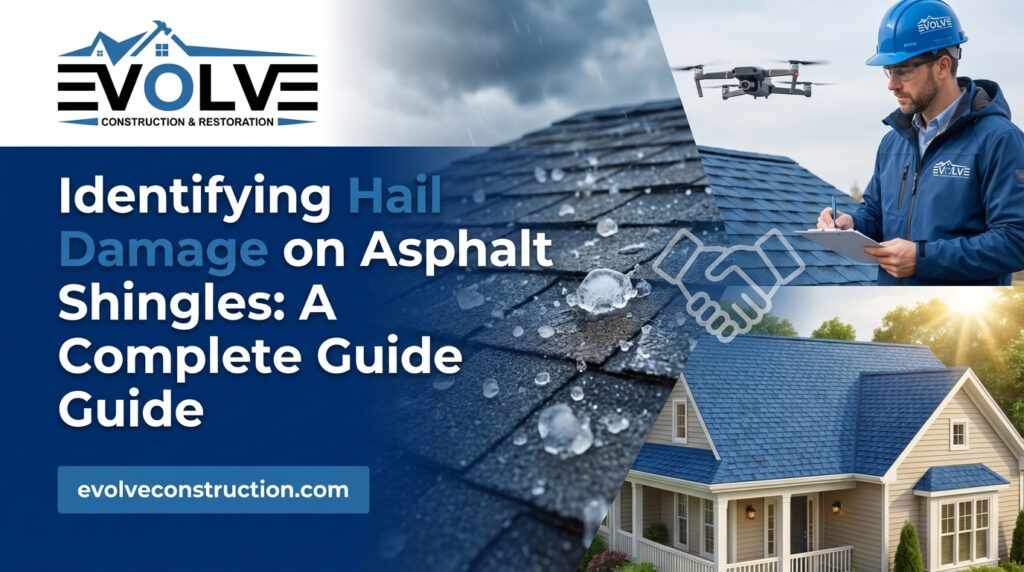
To identify hail damage on asphalt shingles, look for dark, circular soft spots often referred to as “bruises,” significant granule loss in gutters, and circular cracking in the shingle mat. You should also inspect “soft metals” like roof vents and flashing for dents. If damage is subtle, professional inspectors often use a chalk-rub technique to highlight impacts that are invisible to the naked eye.
1. Introduction: Why Hail Damage is Often a “Hidden” Threat
After a severe storm, most homeowners step outside and look for missing shingles or obvious leaks. If the roof looks intact from the driveway, they assume they have escaped unscathed. However, identifying hail damage on asphalt shingles is rarely that straightforward. Unlike wind damage, which is visually dramatic, hail damage is often subtle, cumulative, and latent. It acts like a slow-burning fuse that compromises the integrity of your home over months or years rather than minutes.
The primary purpose of the granules on your asphalt shingles is to protect the underlying bitumen (asphalt) from ultraviolet (UV) radiation. When hail strikes a shingle, it creates a microscopic fracture and dislodges these protective granules. Without this shield, the sun’s rays begin to bake the exposed asphalt, causing it to become brittle, crack, and eventually leak. This is why a roof that doesn’t leak today can fail catastrophically in two years.
Understanding how to spot these signs early is the difference between a successful insurance claim and an out-of-pocket roof replacement down the road. In this guide, we will walk you through the professional methods for identifying hail damage on asphalt shingles, from ground-level clues to advanced on-roof inspection techniques used by industry experts at Evolve Construction.
2. Visual Anatomy of a Hail Hit: Dents, Bruises, and Cracks
The “Apple Bruise” Texture
One of the most common ways to identify hail damage on asphalt shingles is by looking for “bruising.” When a hailstone hits a shingle, it compresses the fiberglass matting and the asphalt layer. If you were to press your thumb into the center of the hit, it would feel soft or spongy, much like the bruise on an apple. These bruises are usually dark in color because the granules have been driven into the shingle or knocked away, revealing the dark asphalt underneath.
Granule Displacement and Bald Spots
Granule loss is the most immediate sign of hail impact. You may notice small “bald spots” where the colorful ceramic granules have vanished. These spots are often circular or teardrop-shaped, depending on the angle of the hailfall. While some granule loss is normal as a roof ages, hail-induced loss is concentrated around the impact sites. If you see fresh, dark asphalt exposed, it is a high-priority sign that the shingle’s UV protection has been compromised.
Mat Fractures and Circular Cracking
In severe cases, the force of the hail is enough to physically crack the internal fiberglass mat of the shingle. These fractures may appear as circular cracks or star-shaped patterns radiating from a central point. These are critical failures because they provide a direct path for water to reach the roof deck. Even if the crack is hair-thin, the expansion and contraction of the roof during temperature changes will eventually widen it, leading to internal water damage and mold growth.
3. The Ground-Level Check: Spotting Collateral Damage First
Inspecting “Soft Metals” and Gutters
Before climbing a ladder, look at the softer materials around your home. Soft metals, such as aluminum gutters, downspouts, and roof vents, are excellent indicators of hail size and intensity. If you see dings or dents in your gutters, it is a mathematical certainty that your shingles—which are softer than metal—have also sustained damage. Check the metal flashing around your chimney or the aluminum fins on your air conditioning unit for similar signs of impact.
Granule Accumulation in Downspouts
Check the discharge ends of your downspouts. A significant amount of “sand” or granules washed out after a storm is a major red flag. While a small amount of sediment is normal, a sudden influx of granules indicates that the hail has scrubbed the shingles clean. If you can see piles of granules near your splash blocks, your roof has likely lost years of its functional lifespan in a single afternoon.
Looking for Spatter Marks
Spatter marks, or “splatter,” are temporary marks left on fences, siding, or decks when hail removes the oxidation (the chalky film) from the surface. While these marks don’t represent permanent damage to a wood fence, they serve as a “map” of the storm. The size and density of the spatter marks tell you exactly how large the hailstones were and from which direction they were traveling, which helps focus your roof inspection on the most affected slopes.
4. Advanced Identification: Using the Chalk Test for Subtle Impacts
Sometimes, identifying hail damage on asphalt shingles is impossible with the naked eye, especially on newer architectural shingles with high-texture profiles. Professional adjusters use a technique called the “Chalk Rub” to reveal hidden damage. This involves taking a piece of common sidewalk chalk and rubbing it sideways over a suspected impact area. The chalk will coat the high points of the granules but will not reach the indentation left by the hail.
This technique creates a visual “negative” of the damage. If a circular void appears where the chalk didn’t touch, you have a confirmed hail hit. This is an essential step for documenting insurance claims, as it provides clear photographic evidence that the shingle mat has been depressed. Many claims are denied because the adjuster couldn’t see the damage in standard photos; the chalk test removes all ambiguity.
When performing a chalk test, focus on a 10-foot by 10-foot area, known in the industry as a “square.” If you find a certain number of hits (typically 6 to 10 depending on the carrier) within that square, the insurance company is much more likely to approve a full roof replacement rather than a simple repair. This systematic approach ensures that the true extent of the storm’s impact is recorded for the record.
5. Differentiating Hail Damage from Common Roof Aging (Blisters vs. Hits)
Shape
Circular, indented, or bruised
Raised bubbles or small pits
Texture
Soft, spongy matting
Brittle, hard edges
Location
Found on metal vents too
Only on shingles; vents are clear
Understanding Asphalt Blistering
One of the most common mistakes in identifying hail damage on asphalt shingles is confusing hail hits with “blistering.” Blistering occurs during the manufacturing process or due to poor attic ventilation. When moisture is trapped inside the shingle, heat causes it to expand, creating a small bubble. Eventually, the top of the bubble pops, leaving a small pit. Unlike hail, blistering does not leave a bruise on the underlying mat; it is purely a surface-level defect related to age and heat.
Weathering and Thermal Cracking
As shingles age, they naturally lose granules and develop small horizontal cracks due to thermal expansion and contraction. This is often called “craze cracking.” To distinguish this from hail, look at the orientation of the marks. Weathering usually affects the entire roof evenly, whereas hail damage is directional. If the north side of your roof is covered in marks but the south side is clean, you are likely looking at storm damage, not general wear and tear.
6. Factors That Determine Damage: Size, Speed, and Shingle Type
Impact of Roof Pitch and Wind Direction
The angle of your roof plays a massive role in whether hail causes damage. A steep-pitched roof may suffer less damage from vertical-falling hail because the impact is a “glancing blow” rather than a direct hit. However, if the hail is wind-driven, it can hit a steep roof at a 90-degree angle, causing significant destruction. When identifying hail damage on asphalt shingles, always pay closest attention to the windward side of the home—the direction the storm came from.
3-Tab vs. Architectural Resilience
Not all shingles react to hail in the same way. Traditional 3-tab shingles are thinner and more prone to mat fractures from smaller hailstones (pea to marble-sized). Architectural (laminate) shingles are much thicker and more resilient, often requiring golf ball-sized hail to cause a full mat fracture. However, because architectural shingles are more expensive, even “cosmetic” damage to them can represent a significant loss in property value. It is important to know which grade of shingle you have before assessing the severity of the hits.
7. Functional vs. Cosmetic Damage: What Your Insurance Policy Cares About
In the world of insurance, there is a major distinction between functional and cosmetic damage. Functional damage is defined as any impact that reduces the shingle’s ability to shed water or shortens its expected lifespan. This includes mat fractures, significant granule loss, and bruising. Most standard insurance policies are required to cover functional damage because it represents a loss of the roof’s primary purpose: protection.
Cosmetic damage refers to marks that affect the appearance of the roof but do not theoretically compromise its performance. Some newer insurance policies have “cosmetic damage waivers” that exclude coverage for dents in metal vents or minor granule loss that doesn’t expose the asphalt. However, it is important to argue that any loss of granules leads to accelerated UV degradation, which eventually becomes functional damage. Using the correct terminology when speaking to an adjuster—emphasizing “diminished life expectancy” and “exposed bitumen”—can help bridge this gap.
According to the National Roofing Contractors Association (NRCA), any impact that compromises the long-term integrity of the roofing system should be considered for repair or replacement. Our team at Evolve Construction works closely with homeowners to ensure that adjusters see the long-term risks, not just the current surface appearance.
8. How to Document Damage and Avoid “Storm Chaser” Scams
Professional Photo Documentation
If you suspect damage, start documenting immediately. Take wide-angle photos of the entire roof slope and close-up photos of specific hits. Use an object for scale, such as a coin or a tape measure, to show the size of the hailstones or the impact marks. If you can find actual hailstones, place them in a bag in your freezer; this provides undeniable proof of the hail size during the event. Comprehensive documentation is the best way to speed up the insurance claim process.
Identifying Out-of-State “Storm Chasers”
Immediately following a major hail event, your neighborhood will likely be flooded with “storm chasers.” These are often out-of-state contractors who follow weather maps to find damage. While some may be legitimate, many provide subpar workmanship, use cheap materials, and disappear as soon as the check clears, leaving you with no warranty support. Red flags include high-pressure sales tactics, requests for full payment upfront, and a lack of a local physical office or local references.
Always choose a reputable, local company like Evolve Construction. A local contractor has a vested interest in the community and will be there to honor your warranty years after the storm has passed. We provide honest assessments and stand by our work, ensuring your home is rebuilt for a better tomorrow.
9. Conclusion: Immediate Next Steps After a Storm
Identifying hail damage on asphalt shingles is a critical skill for any homeowner, but it is only the first step. If your ground-level check reveals dented gutters or piles of granules, or if your roof-level check shows bruising and mat fractures, you must act quickly. Most insurance policies have a “statute of limitations” for storm claims, often ranging from one to two years. Waiting too long can result in a denied claim, even if the damage is undeniable.
The most effective way to protect your investment is to schedule a professional inspection with an expert who understands the nuances of hail impacts. A trained eye can spot the latent damage that leads to leaks and can help you navigate the complex insurance landscape. At Evolve Construction, we specialize in storm damage restoration, bringing transparency and expertise to every project.
Ready to Get Started?
Our honest, friendly, and reputable professionals help homeowners and businesses maximize the value of their property and stand together with them to rebuild for a better tomorrow, especially after challenging storm events.