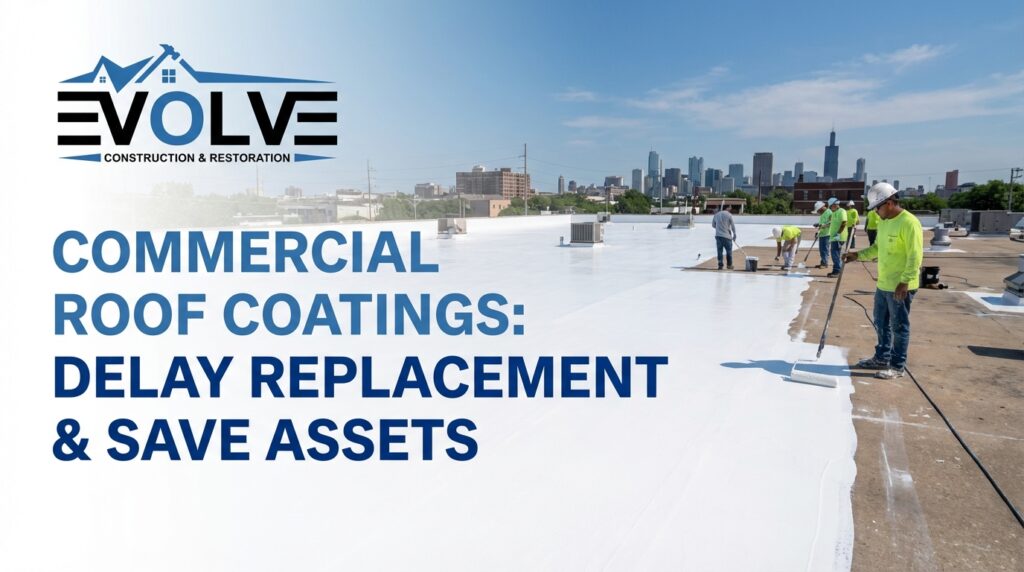
Commercial Roof Coatings: The Asset Manager’s Guide to Delaying Replacement
Can a commercial roof coating really delay a full replacement by decades? Yes, commercial roof coatings allow property owners to delay a full replacement by 10 to 20 years by creating a seamless, waterproof membrane over the existing substrate. This process involves a diagnostic moisture survey, minor repairs, and the application of high-reflectivity polymers like silicone or acrylic, often qualifying as a tax-deductible maintenance expense rather than a multi-million dollar capital expenditure.
1. The Asset Management Case for Roof Restoration
For commercial property managers and CFOs, a roof is more than just a shelter; it is a high-value physical asset that directly impacts the bottom line. Traditional reactive maintenance often leads to a cycle of expensive emergency repairs followed by a premature, disruptive tear-off and replacement. Shifting from a “fail-and-fix” mentality to a proactive asset management strategy involves identifying the exact moment when a roof can still be saved. Restoration via advanced coating systems offers a bridge between the end of a roof’s design life and the massive capital hit of a replacement.
The Economics of Proactive Restoration
When you choose to restore rather than replace, you are effectively extending the depreciation cycle of the existing asset. A typical commercial roof might have a 20-year lifespan, but environmental stressors like UV radiation and thermal shock often cause failure at year 15. By intervening at year 12 or 13 with a high-performance coating, you reset the clock. This avoids the high labor costs associated with a full tear-off and significantly reduces material waste, keeping the building’s operational budget predictable.
Understanding the Scope of Commercial Assets
Commercial assets range from sprawling industrial warehouses to multi-story retail centers. Each of these structures faces unique stressors, such as heavy HVAC equipment loads or chemical exposure. Coatings provide a versatile solution that adapts to these diverse needs. Unlike rigid membrane systems, liquid-applied coatings create a monolithic layer that encapsulates penetrations, curbs, and flashing, which are the most common points of failure in commercial roofing systems.
2. The Science of Life Extension: How Coatings Stop Aging
Roofing materials degrade primarily due to photo-oxidation caused by ultraviolet (UV) radiation from the sun. On a standard bitumen or TPO roof, this UV exposure causes the materials to become brittle and lose their flexibility over time. Once a roof loses its ability to expand and contract with temperature changes—a process known as thermal expansion—it begins to crack and leak. Commercial roof coatings act as a sacrificial barrier, absorbing the UV punishment so the underlying structure doesn’t have to.
The Role of High Albedo and Reflectivity
Modern elastomeric coatings are designed with high albedo, meaning they reflect a significant portion of solar energy back into the atmosphere. While a dark EPDM roof can reach temperatures exceeding 160°F on a summer day, a white silicone coating can keep the surface within 10-15 degrees of the ambient air temperature. This reduction in heat absorption stops the “cooking” of the roof substrate, effectively halting the chemical degradation of the older roofing materials beneath the coating.
Monolithic Protection and Seamless Integration
Seams are the Achilles’ heel of any roofing system. Whether they are heat-welded or glued, seams eventually fail due to constant movement and moisture infiltration. Coatings are liquid-applied, meaning they have no seams. When applied correctly, they form a single, continuous rubber-like membrane that covers the entire roof deck. This eliminates thousands of feet of potential leak points, providing a level of waterproofing that traditional sheet goods simply cannot match over the long term.
3. Diagnostic Phase: Is Your Roof a Candidate? (ASTM D7954)
Not every roof is a candidate for a coating. The most critical step in the restoration process is a comprehensive diagnostic evaluation to ensure that the underlying insulation is dry. Applying a coating over wet insulation is a recipe for disaster; it traps moisture inside the assembly, leading to structural rot and mold. Legitimate contractors use standardized protocols like ASTM D7954 to identify trapped moisture before any coating is applied.
Infrared Thermography and Moisture Surveys
Infrared (IR) thermography is a non-destructive testing method that identifies “hot spots” on a roof at night. Because water has a high thermal mass, wet insulation holds onto the sun’s heat longer than dry insulation. An IR camera can see these temperature differentials, allowing technicians to map out exactly where the roof is failing. If less than 20-25% of the roof is saturated, it is generally considered a prime candidate for localized repairs and a full-surface coating.
Nuclear and Impedance Scanning
In addition to IR, impedance scanners (like the Tramex system) use electrical signals to measure the conductivity of the roof assembly. Since water is highly conductive, these tools provide a secondary layer of verification. By combining these technologies, Evolve Construction can provide a “moisture map” that proves to the building owner that a coating is a viable, long-term solution rather than a temporary patch over a failing system.
4. Choosing the Right Polymer: Silicone vs. Acrylic vs. Polyurethane
Selecting the right chemistry is vital for the success of a roof restoration project. Different environments—ranging from the humid Southeast to the freezing North—require different polymer properties. Using the wrong material can lead to delamination, premature wear, or failure to stop leaks. Understanding the strengths and weaknesses of each system ensures that your commercial asset is protected for the next 10 to 20 years.
Silicone Coatings: The Gold Standard for Ponding Water
Silicone is currently the most popular choice for commercial restoration. It is highly UV-stable and, most importantly, it is inorganic. This means it does not break down under standing water. If your commercial roof has areas of “ponding water” that don’t drain within 48 hours, silicone is the only coating that will maintain its integrity and warranty coverage. It remains flexible in extreme cold and resists the chalking that affects other materials.
Acrylic and Polyurethane Alternatives
Acrylic coatings are a cost-effective solution for roofs with excellent drainage and mild climates. They are water-based and easy to apply but can be susceptible to damage from long-term ponding water. Polyurethane coatings, on the other hand, offer incredible impact resistance. They are often used as a base coat in high-traffic areas or in regions prone to heavy hail, providing a “harder” shell than silicone while still maintaining waterproofing properties.
5. Financial Engineering: Using IRS Section 179 and 162
The decision to coat a roof is often as much a financial one as it is a structural one. Under current US tax law, the way you classify a roofing project can have a massive impact on your annual tax liability. A full roof replacement is typically classified as a “capital improvement,” meaning the cost must be depreciated over 39 years for commercial buildings. In contrast, a roof coating is often classified as a “maintenance expense,” which can potentially be deducted in full in the year the work is performed.
Section 162: The Maintenance Advantage
IRS Section 162 allows businesses to deduct the cost of repairs and maintenance that keep a property in its ordinarily efficient operating condition. Because a coating system does not involve replacing the structural deck or the entire membrane assembly, tax professionals often argue that it is a restorative maintenance procedure. This immediate expensing allows property owners to keep more cash flow in the business today rather than waiting decades for depreciation to play out.
Section 179 Expensing for Roofs
The Tax Cuts and Jobs Act expanded Section 179 to include commercial roofing improvements. This allows for the immediate expensing of certain qualified real property. By utilizing these tax codes, a $100,000 coating project could effectively cost the company significantly less after tax savings are realized in year one. We always recommend consulting with a CPA to maximize the specific benefits for your asset portfolio.
6. The 20-Year ROI: Restoration vs. Replacement Cost Modeling
When comparing a coating to a replacement, you must look beyond the initial invoice. A replacement involves tear-off labor, landfill disposal fees, new insulation, and new membrane costs. A coating project typically costs 30% to 50% less than a full replacement. However, the real value is revealed over a 20-year horizon through energy savings and the avoidance of a second replacement cycle.
Energy Cost Reduction and the ‘Cool Roof’ Effect
According to the Department of Energy, cool roofs can reduce peak cooling demand by 10-15%. For a large commercial building, this translates to thousands of dollars in monthly utility savings. These savings continue for the life of the coating. Furthermore, the lower surface temperatures reduce the strain on rooftop HVAC units, extending their mechanical lifespan and reducing maintenance calls for air conditioning failure.
The ‘Infinite’ Roof Lifecycle
One of the most powerful aspects of coatings is that they are renewable. At the end of a 10 or 15-year warranty period, the roof can simply be cleaned and “re-coated” with a new top layer. This adds another 10-15 years of life. By repeating this process, a property owner can theoretically avoid a full roof tear-off for the entire duration of their ownership, keeping the building’s envelope secure at a fraction of the cost of traditional methods.
7. Operational Continuity: Coating Without the Disruption
For many commercial businesses—such as hospitals, data centers, and high-end retail—the biggest cost of a roof replacement isn’t the contractor’s bill; it’s the operational downtime. A traditional tear-off is loud, messy, and creates significant risk for interior water damage during the construction phase. Roof coatings eliminate almost all of these logistical headaches, allowing the business to operate as usual.
Low Noise and Odor Profiles
Replacement projects involve cranes, heavy machinery, and the constant banging of fasteners into the steel or concrete deck. This noise can be intolerable for office workers or tenants. Coatings are applied using sprayers or rollers, creating very little noise. Additionally, modern silicone coatings are low-VOC (Volatile Organic Compounds), meaning there are no harsh chemical odors that can enter the building’s air intake systems.
Mitigating Interior Risk
When you tear off a roof, you expose the interior of the building to the elements. A sudden rainstorm during a replacement can cause catastrophic damage to inventory, electronics, and interior finishes. Because a coating system is applied directly over the existing, functional roof, the building remains sealed throughout the entire process. There is no “open roof” period, providing peace of mind for both the owner and the tenants.
8. Sustainability & ESG: Moving Toward a Zero-Waste Building
Environmental, Social, and Governance (ESG) metrics are becoming increasingly important for commercial property owners and REITs. Roofing is one of the largest contributors to landfill waste in the construction industry. By choosing to restore your roof rather than tear it off, you are making a measurable impact on your company’s sustainability goals and carbon footprint.
Landfill Diversion and Waste Reduction
A typical commercial roof replacement can generate tens of thousands of pounds of waste, much of which is non-biodegradable petroleum-based material. Restoration keeps that material on the roof and out of the landfill. For companies tracking waste diversion rates for GRESB or LEED reporting, roof restoration is one of the most significant single-event improvements you can make to a building’s environmental profile.
Scope 2 Emission Reductions
Scope 2 emissions include the indirect greenhouse gas emissions from the generation of purchased energy. Because cool roof coatings significantly reduce the amount of electricity required to cool a building, they directly lower the building’s Scope 2 emissions. This data can be quantified and included in annual corporate social responsibility (CSR) reports, demonstrating a commitment to energy efficiency and environmental stewardship to investors and stakeholders.
9. Ethical Restoration: Navigating Insurance and Financing Scams
While roof restoration is a brilliant financial move, the industry is unfortunately plagued by bad actors. It is important to remember that it is illegal to “waive” or “cover” a homeowner’s or business’s insurance deductible. Some sales reps may promise this as an incentive to get your business, but this practice constitutes insurance fraud in most jurisdictions. Legitimate companies cannot and will not waive deductibles because it compromises the integrity of the claim and the contract with the carrier.
Warning Against the “Free Roof” Scam
If a roofer tells you they can handle your insurance claim and ensure you pay nothing out of pocket by manipulating the invoice to cover your deductible, they are asking you to participate in a crime. This often leads to the use of inferior materials or skipped steps to make up the price difference. At Evolve Construction, we believe in radical transparency. We educate our clients on the law and why maintaining ethical standards protects the building owner from future legal and financial liability.
How Evolve Helps Ethically: Financing and Charity
Instead of cutting corners or breaking the law, Evolve helps property owners manage costs through legitimate financial avenues. We offer robust financing options, including zero-down and no-interest plans, to help bridge the gap between insurance payouts and the total cost of high-quality restoration. Furthermore, through The Evolve Foundation, we provide charitable assistance to those in our community who are truly in need. We believe in building a better tomorrow through honesty and community support, not through deceptive sales tactics.
10. Warranty Strategy: Securing NDL Protection
A coating is only as good as the warranty that backs it. In the commercial world, you should look for a “No Dollar Limit” (NDL) warranty. Standard material-only warranties are often weak; they only cover the cost of the liquid coating if it is proven defective, leaving the building owner to pay for the expensive labor of a repair. An NDL warranty, backed by a major manufacturer like GAF, Carlisle, or Mule-Hide, ensures that the manufacturer will cover the full cost of any repairs needed to keep the roof watertight.
The Importance of Manufacturer Inspections
To secure an NDL warranty on a restoration project, the manufacturer’s representative must inspect the roof before, during, and after the application. This provides an extra layer of quality control for the asset manager. The manufacturer will verify that the moisture survey was performed, that the repairs were made to their standards, and that the coating was applied at the correct wet-film thickness (WFT) to ensure the final dry-film thickness (DFT) meets the warranty requirements.
Warranty Transferability and Asset Value
If you plan to sell your commercial property within the next 10 years, a transferable NDL warranty is a significant selling point. It provides the buyer with documented proof that the building envelope is secure and backed by a multi-billion dollar manufacturer. This reduces the risk for the buyer and can lead to a higher valuation during the due diligence process, making the coating project an investment that pays off during the exit strategy.
11. Implementation & Maintenance: The Lifecycle Checklist
Applying the coating is the beginning of the restoration’s life, not the end. To maximize the 20-year ROI, a basic maintenance plan must be followed. Commercial roofs are active environments, with HVAC technicians and other trades walking across them regularly. Proper maintenance ensures that accidental damage doesn’t turn into a major leak.
The Bi-Annual Inspection Protocol
We recommend inspections every spring and fall. These inspections focus on clearing debris from drains and scuppers, checking that walkway pads are secure, and ensuring that no new penetrations have been added without proper flashing. Small punctures from dropped tools or wind-blown debris can be easily repaired with a small amount of compatible sealant if caught early, preserving the integrity of the monolithic coating.
Cleaning for Reflectivity
Over time, dirt and pollution can accumulate on the surface of a white coating, slightly reducing its solar reflectance. Periodic cleaning—usually just with water and a soft-bristled broom—can restore the albedo of the roof, ensuring that you continue to receive the maximum energy savings throughout the life of the system. This simple step keeps the building running efficiently and ensures the coating continues to look professional for tenants and visitors.
Ready to Get Started?
Our honest, friendly, and reputable professionals help homeowners and businesses maximize the value of their property and stand together with them to rebuild for a better tomorrow, especially after challenging storm events.