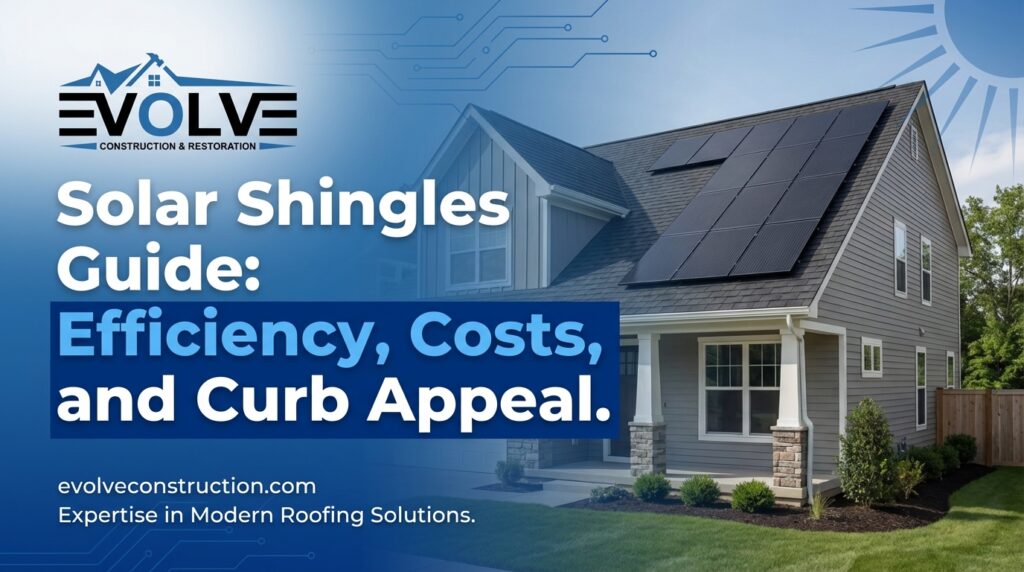
Solar Shingles: The Ultimate Guide to Combining Energy Efficiency and Curb Appeal
For decades, homeowners faced a difficult choice: lower their carbon footprint and electricity bills with bulky solar panels, or maintain the pristine architectural integrity of their homes. Today, that compromise is becoming a thing of the past. Solar shingles, the leading edge of Building-Integrated Photovoltaics (BIPV), have revolutionized the industry by transforming the roof itself into a power-generating asset. Unlike traditional rack-mounted panels, these shingles blend seamlessly into the roofline, offering a sophisticated aesthetic that appeals to even the most design-conscious property owners.
At Evolve Construction, we understand that your home is both a sanctuary and a significant investment. As a leader in roofing and restoration, we have seen firsthand how solar technology has evolved from industrial-looking additions to elegant, functional building materials. Whether you are rebuilding after a storm or looking to modernize your home’s efficiency, understanding the nuances of solar shingles is the first step toward a smarter, more beautiful property.
Solar shingles are a type of solar energy system designed to look and function like traditional roofing materials, such as asphalt or slate, while generating electricity. Known as Building-Integrated Photovoltaics (BIPV), they replace standard shingles entirely, acting as both a protective weather barrier for your home and a clean energy source.
1. The Science of BIPV: How Solar Shingles Replace Traditional Roofing
To understand the value of solar shingles, one must first understand the concept of Building-Integrated Photovoltaics, or BIPV. Traditional solar systems are “applied” to a building, meaning they are bolted onto an existing structure. BIPV materials, however, are “integrated.” This means the solar shingles serve a dual purpose: they are the primary roofing material that protects your home from rain, wind, and sun, and they are also the semi-conductive layer that captures photons to create electricity.
Monocrystalline vs. Thin-Film Technology
Most high-end solar shingles, such as those from Tesla or CertainTeed, utilize monocrystalline silicon cells. These are sliced from a single, pure crystal of silicon, making them highly efficient at converting sunlight into power even in smaller footprints. Conversely, some flexible solar shingles use thin-film technology (CIGS – Copper Indium Gallium Selenide). While thin-film is generally less efficient than monocrystalline, it is lighter and more flexible, making it ideal for certain architectural shapes or lower-weight requirements.
Structural Integrity and Connectivity
A common concern for homeowners is whether a “solar roof” is as strong as a “real roof.” Solar shingles are engineered to be exceptionally durable. Each shingle is wired into a system that feeds into an inverter, converting Direct Current (DC) into the Alternating Current (AC) used by your home appliances. Because they are installed directly onto the roof deck, they eliminate the need for the heavy mounting racks and roof penetrations required by traditional panels, which can sometimes lead to leaks if not handled by professionals like our team at Evolve Construction.
2. The Curb Appeal Factor: Aesthetic Integration vs. Bulky Solar Panels
The primary driver for the adoption of solar shingles is undoubtedly aesthetics. Traditional solar panels can be an eyesore, particularly on historic homes or houses with complex rooflines. They sit several inches off the roof, creating a tiered look that many homeowners find unappealing. Solar shingles solve this by maintaining a low profile. From the street, most people cannot distinguish a solar shingle roof from a high-end slate or architectural asphalt roof.
Seamless Design Integration
Manufacturers have gone to great lengths to ensure their products mimic traditional materials. For instance, Tesla’s Solar Roof uses tempered glass tiles that come in various textures, while GAF Energy’s Timberline Solar shingles are designed to nail directly into the roof alongside standard asphalt shingles. This creates a uniform look where the solar components are virtually invisible to the untrained eye, preserving the “curb appeal” that is so vital for resale value.
HOA Approval and Architectural Harmony
Homeowners Associations (HOAs) have historically been a hurdle for solar adoption due to strict rules regarding neighborhood appearance. Solar shingles are the “great compromise.” Because they look like standard roofing, they are far more likely to receive quick approval from architectural review boards. In many states, “Solar Access” laws prevent HOAs from banning solar entirely, but they can still enforce aesthetic standards. Solar shingles meet these standards effortlessly while providing the green energy homeowners desire.
3. Performance Metrics: Real-World Efficiency and Energy Output
When discussing performance, it is important to be transparent: traditional solar panels are currently more efficient per square inch than solar shingles. While a premium solar panel might offer 20% to 22% efficiency, most solar shingles hover between 14% and 18%. This gap exists because shingles lack the airflow that panels enjoy; panels are elevated, allowing wind to cool them from behind, whereas shingles sit flush against the roof deck and can get much hotter.
Temperature Coefficients and Heat Performance
Solar cells actually become less efficient as they get hotter. This is known as the temperature coefficient. Because solar shingles are in direct contact with the roof, they require advanced material science to manage heat. Leading brands use specialized backsheets and heat-dissipating materials to ensure that even on a mid-summer day in Florida or Texas, the shingles continue to produce steady power without degrading the underlying roof structure.
Annual Energy Yield
Despite the lower efficiency rating per cell, solar shingles often make up for it in coverage. Because they are smaller and more modular, installers can place them in areas where a large, rectangular panel might not fit. By maximizing the usable surface area of the roof, the total annual energy yield of a solar shingle system can often match or even exceed that of a smaller, traditional panel array, providing enough power to significantly offset or entirely eliminate your monthly utility bill.
4. Comparative Analysis: Solar Shingles vs. Traditional Photovoltaic (PV) Panels
Choosing between shingles and panels requires a side-by-side look at the priorities of the homeowner. If the goal is the absolute lowest cost per watt, traditional panels remain the winner. However, if the goal is a comprehensive roofing solution that enhances property value and longevity, shingles offer a compelling case. Below is a breakdown of how these two technologies compare across key metrics.
Aesthetics
Seamless, low-profile, high curb appeal
Bulky, visible racks, industrial look
Installation
Installed as part of a new roof
Mounted on top of an existing roof
Efficiency
14% – 18%
20% – 22%
Durability
Excellent (Wind/Hail/Fire rated)
High (but adds weight to structure)
Cost
Higher upfront (includes new roof)
Lower upfront
5. Top 2025 Manufacturers: Ranking Tesla, GAF Energy, CertainTeed, and Luma
The market for solar shingles has matured significantly over the last few years. Several key players have emerged, each offering a unique value proposition. At Evolve Construction, we keep a close eye on these manufacturers to ensure we recommend the best products for our clients’ specific climate and architectural needs.
Tesla Solar Roof
Tesla remains the most famous name in the space. Their Solar Roof consists of high-strength glass tiles that are virtually indestructible. Tesla tiles are known for their exceptional beauty and integration with the Tesla Powerwall, creating a complete home energy ecosystem. However, Tesla systems are typically the most expensive and require specialized installation teams.
GAF Energy: Timberline Solar
GAF Energy changed the game with the Timberline Solar shingle. Unlike Tesla, which uses glass tiles, GAF created a “nailable” solar shingle. This allows traditional roofing crews to install the solar components using the same tools they use for asphalt shingles. It is significantly more affordable than Tesla and is designed to integrate with GAF’s massive existing roofing network, making it the most accessible option for the average homeowner.
CertainTeed: Solstice and Apollo
CertainTeed offers a middle ground with their Solstice and Apollo lines. These shingles are designed to fit perfectly with CertainTeed’s high-end asphalt shingles. They offer high efficiency and a sleek, black-on-black look. One of the biggest advantages of CertainTeed is their comprehensive warranty, which covers both the roofing and the solar generation, giving homeowners peace of mind.
6. Financial Breakdown: Upfront Costs, Tax Credits, and Long-Term Savings
Let’s talk numbers. A solar shingle roof is a premium investment. Typically, a full solar roof installation can cost between $30,000 and $70,000 depending on the size of the home and the energy requirements. While this is higher than a standard roof, it is crucial to view this as two separate investments: a necessary home repair (the roof) and a long-term utility hedge (the solar system).
The Federal Solar Tax Credit (ITC)
The most significant financial incentive is the Federal Investment Tax Credit (ITC). As of 2024-2025, homeowners can deduct 30% of the total cost of their solar shingle system—including the cost of the solar-active portion of the roof—from their federal income taxes. On a $50,000 system, this represents a $15,000 direct saving. When combined with local state incentives and net metering (where the utility company pays you for excess power), the Return on Investment (ROI) period is often between 7 and 12 years.
Increased Property Value
Studies from Zillow and the Lawrence Berkeley National Laboratory consistently show that homes with solar energy systems sell for more than homes without them—often a 4% premium. For a $500,000 home, that is an extra $20,000 in equity. Unlike traditional panels, which some buyers may find unattractive, solar shingles are generally viewed as a high-end architectural upgrade, making the home even more desirable on the open market.
7. Installation and Longevity: Why Timing Matters (New Roof vs. Retrofit)
The ideal time to install solar shingles is when you already need a new roof. Because solar shingles replace your existing roofing material, retrofitting them onto a roof that is only 5 or 10 years old is often not cost-effective. You would essentially be throwing away perfectly good shingles to install the solar ones. However, if your roof has reached the end of its life or has been damaged by a major storm, the incremental cost of upgrading to solar shingles is much lower.
The Installation Process
A typical solar shingle installation takes longer than a standard asphalt job but shorter than a traditional solar panel install plus a new roof. It involves stripping the old roof, installing a high-temperature underlayment, and then meticulously laying the solar shingles in the high-sun areas of the roof while using matching “non-active” shingles in the valleys and shaded areas. This ensures a uniform look across the entire structure.
Maintenance and Walkability
One common question we hear at Evolve Construction is: “Can I walk on it?” Most modern solar shingles, like those from GAF and Tesla, are designed to be walkable. This is critical for routine maintenance like gutter cleaning or chimney repair. However, care should still be taken, and we recommend professional cleaning once or twice a year to remove dust, pollen, or debris that might block sunlight and lower efficiency.
8. Weathering the Storm: Durability Ratings for Wind, Hail, and Snow
As a company that specializes in storm damage restoration, we prioritize durability. Many homeowners worry that “glass” on their roof will shatter during a hail storm. In reality, solar shingles are often tougher than the asphalt shingles they replace. Most premium solar shingles carry a Class 4 Hail Rating (the highest possible), meaning they can withstand 2-inch hail stones traveling at high speeds without cracking.
Wind and Fire Resistance
High-wind environments, such as coastal regions or the Midwest, require roofing that won’t blow away. Solar shingles are tested to withstand winds up to 130 mph (ASTM D3161 Class F). Furthermore, they carry a Class A fire rating, the highest rating available, providing essential protection for your family. This durability makes them an excellent choice for homeowners in areas prone to severe weather events.
9. The Hybrid Approach: Maximizing Efficiency and Aesthetics on a Budget
For homeowners who love the look of solar shingles but are concerned about the total cost or efficiency, we often recommend a “Hybrid Installation Strategy.” This is one of our unique industry insights at Evolve Construction. In this scenario, we install beautiful solar shingles on the street-facing portions of the roof to maximize curb appeal. On the rear-facing or flat portions of the roof where they aren’t visible, we install high-efficiency traditional solar panels.
Best of Both Worlds
This strategy allows you to get the “stealth” look for your home’s public profile while benefiting from the higher power output and lower cost of traditional panels where aesthetics don’t matter. It is a smart way to hit your energy production goals without breaking the bank or sacrificing the architectural beauty of your property.
10. Smart Home Ecosystems: Integrating Shingles with Modern Battery Storage
A solar roof is only as good as the system that manages its energy. Modern solar shingle installations are increasingly paired with Home Energy Management Systems (HEMS). These systems allow you to monitor your energy production and consumption in real-time through a smartphone app. You can see exactly how much power your roof is generating at 10:00 AM versus 2:00 PM and adjust your appliance usage accordingly.
Battery Storage and Energy Independence
Integrating solar shingles with battery storage—like the Tesla Powerwall or Enphase IQ Battery—is the ultimate way to achieve energy independence. During a storm or a grid failure, your solar shingles can continue to charge your batteries, keeping your lights, refrigerator, and medical equipment running. At Evolve Construction, we emphasize this resilience, especially for our clients who have lived through the uncertainty of power outages following major storms.
Conclusion: Is the Investment in Solar Shingles Right for Your Home?
Solar shingles represent the perfect marriage of form and function. They offer a way to participate in the green energy revolution without turning your home into a science experiment. While the upfront cost is higher than traditional panels, the combination of long-term energy savings, tax incentives, increased property value, and undeniable curb appeal makes them an excellent choice for many homeowners.
If you are currently looking at a roof replacement, particularly if it’s due to storm damage, there has never been a better time to consider solar shingles. By integrating energy generation into your restoration process, you aren’t just fixing a problem—you are building a better, more efficient tomorrow for your family.
Ready to Get Started?
Our honest, friendly, and reputable professionals help homeowners and businesses maximize the value of their property and stand together with them to rebuild for a better tomorrow, especially after challenging storm events. Whether you are interested in solar shingles or need expert roofing repairs, we are here to help.