Solar Shingles vs. Panels: A Comprehensive Cost and Efficiency Comparison for 2025
Deciding between solar shingles vs. panels is no longer just a question of tech enthusiasts; it is a critical financial decision for homeowners looking to modernize their properties. As we move into 2025, the solar landscape has shifted significantly. Traditional rack-mounted panels remain the industry standard for raw power, but integrated Building-Integrated Photovoltaics (BIPV)—commonly known as solar shingles—have matured into a viable, aesthetically superior alternative. At Evolve Construction, we see firsthand how these two technologies impact both roofing integrity and long-term property value. This guide provides an exhaustive analysis of the costs, performance metrics, and practical realities of both systems to help you choose the best fit for your home.
The Quick Answer for Featured Snippets:
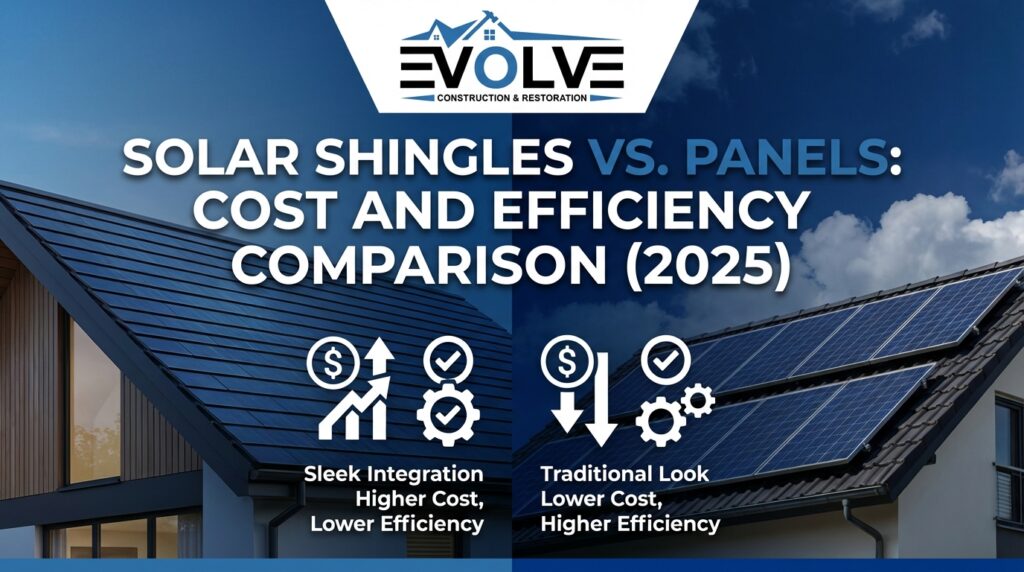
When comparing solar shingles vs. panels, solar panels are generally more efficient (20-22% vs. 14-18%) and cost 30-50% less to install on an existing roof. However, solar shingles offer superior aesthetics and become cost-competitive when combined with a full roof replacement, potentially increasing property value by up to 6% compared to 4% for panels.
1. Introduction: The Evolution of Rooftop Solar in 2025
The debate over solar shingles vs. panels has evolved from a niche architectural discussion into a mainstream construction priority. For decades, solar panels were the only logical choice, characterized by large, rectangular silicon modules bolted onto metal racks. While highly effective, they often clashed with traditional home designs. Enter solar shingles—thin-film or crystalline cells designed to mimic the appearance and function of traditional roofing materials like asphalt or slate. Today, brands like GAF Energy with their Timberline Solar and Tesla’s Solar Roof have bridged the gap between utility and design.
In 2025, the motivation for going solar has expanded beyond simple electricity savings. Homeowners are now considering the “embodied carbon” of their building materials and the resilience of their roofs against increasingly severe weather patterns. Solar shingles represent a holistic approach where the roof itself generates power, whereas panels are an additive layer. Understanding which system suits your lifestyle requires looking past the surface level and into the engineering and financial structures that support each option.
Furthermore, the regulatory environment is changing. With the 2026 Federal Tax Credit cliff approaching, the urgency to understand these systems has never been higher. Whether you are rebuilding after a storm or proactively upgrading your home, the choice between integrated shingles and traditional panels will dictate your maintenance schedule, insurance premiums, and energy independence for the next 25 years.
2. Solar Shingles vs. Solar Panels: A High-Level Comparison Table
To understand the fundamental trade-offs, it is helpful to view the data side-by-side. The following table highlights the technical and financial benchmarks currently observed in the North American market. These figures represent averages and can vary based on local labor rates and specific manufacturer hardware.
Average Efficiency
20% – 23%
14% – 18%
Installation Cost (Avg)
$2.50 – $3.50 per watt
$5.00 – $8.00 per watt
Aesthetic Profile
Visible, raised profile
Flush-mounted, low profile
Installation Time
1–2 days
1–2 weeks (includes roofing)
Durability
High (Tier 1 standards)
Extreme (Roof-grade resilience)
Typical Lifespan
25–30 years
20–25 years
Key Takeaways from the Comparison
As the table suggests, traditional solar panels still hold the crown for raw energy conversion. If your primary goal is maximizing kilowatt-hour (kWh) production per square foot of roof space, panels are the clear winner. However, if you factor in the total cost of a roof replacement plus solar, the numbers for shingles begin to look much more attractive, especially when considering the increased property value associated with high-end, integrated systems.
3. The Financial Reality: Breaking Down Upfront Costs vs. Long-Term ROI
When evaluating solar shingles vs. panels cost, it is crucial to look at more than just the price tag on the quote. Solar panels are a standalone purchase. You are buying hardware, mounting racks, and labor to attach them to your existing roof. For a standard 8kW system, you might expect to pay between $20,000 and $28,000 before incentives. Because panels are modular and mass-produced, the price per watt has plummeted over the last decade, making the ROI (Return on Investment) timeline relatively short—typically between 6 and 9 years.
Solar shingles operate on a different financial model. They are a roofing product that happens to generate electricity. This means you cannot usually install solar shingles without replacing your entire roof (or at least a significant portion of it). An 8kW solar shingle system, including the necessary roofing substrate and non-solar shingles to match, can cost anywhere from $40,000 to $70,000. While this sounds daunting, homeowners who already need a roof replacement can subtract the cost of a traditional roof (roughly $10,000–$20,000) from the solar shingle total, bringing the “net solar cost” closer to that of traditional panels.
The Payback Period Analysis
The ROI for panels is often faster due to lower upfront costs and higher efficiency. A panel system might save you $1,500 annually in electricity, leading to a break-even point in under a decade. Shingles, with their lower efficiency, might only save $1,200 annually while costing more upfront. However, shingles often come with better warranties that cover both the solar performance and the roof’s waterproofing, potentially saving thousands in future repair costs that panels won’t cover.
Financing and Cash Flow
Because solar shingles are integrated into the structure, they are sometimes easier to fold into a mortgage or a home improvement loan compared to panels, which some lenders view as an “appliance” or temporary fixture. At Evolve Construction, we emphasize looking at the 25-year cash flow; shingles often have higher insurance-related benefits and lower maintenance overhead, which can narrow the ROI gap significantly over the system’s life.
4. Efficiency Deep Dive: Why Panels Still Lead in Power Generation
Efficiency is where solar panels maintain a significant technical edge. Standard silicon solar panels utilize large-format cells that can be optimized for light absorption. Because they are mounted on racks, they sit 3 to 6 inches above the roof surface. This gap allows for natural airflow, which is critical because solar cell efficiency drops as temperatures rise. By staying cooler, panels can maintain their peak output even on hot summer afternoons.
Solar shingles, by design, are in direct contact with the roof deck. This lack of airflow leads to higher operating temperatures. For every degree Celsius above the standard testing temperature (25°C), solar cells lose a fraction of their efficiency. This thermal handicap, combined with the smaller surface area of the individual shingle cells, results in a lower overall system efficiency. Most modern shingles hover around 15% efficiency, while high-end panels from manufacturers like SunPower or REC routinely exceed 22%.
Energy Density and Roof Space
If you have a small roof with limited sunlight exposure, panels are almost always the better choice. You can generate the same amount of power with 400 square feet of high-efficiency panels as you would with 600 square feet of solar shingles. For homeowners with massive, south-facing roof planes, the lower efficiency of shingles is less of a deal-breaker, as they have the space to compensate for the lower density by installing more units.
Inverter Technology and Shading
Efficiency isn’t just about the cells; it’s about the system architecture. Traditional panels often use micro-inverters or power optimizers (like those from Enphase or SolarEdge) to manage shading. If one panel is in the dark, the others keep producing. Solar shingles are often wired in complex strings. While newer systems are improving, a single shadow from a chimney can sometimes have a disproportionate impact on a shingle array’s total output compared to a modular panel system. Understanding your local shading profile is essential before committing to BIPV.
5. The ‘Roof Replacement’ Tipping Point: When Shingles Become the Economical Choice
The most important rule in the solar shingles vs. panels debate is the “roofing cycle.” If your roof is less than 5 years old and in excellent condition, installing solar shingles is almost never financially sound. You would be paying to tear off a perfectly good roof. In this scenario, traditional panels are the logical choice; they can be installed with specialized mounts that preserve your existing roof’s warranty.
However, if your roof is 15–20 years old and nearing the end of its life, the math changes completely. This is the “tipping point.” Since you have to pay for a new roof anyway, you can apply that budget toward a solar shingle system. In many cases, the incremental cost of upgrading from a premium asphalt shingle roof to a solar shingle system is comparable to the cost of a new roof plus a separate solar panel array. This “one-and-done” approach simplifies the construction process and ensures that the solar components and the waterproofing layers have synchronized lifespans.
Embodied Carbon and Sustainability
From a sustainability perspective, shingles have a lower “embodied carbon” footprint when installed during a roof replacement. Why? Because you are using one product to do two jobs. With panels, you are using asphalt/petroleum products for the roof AND silicon/aluminum for the panels. By combining them, you reduce the total mass of materials required to protect and power your home. This is an often-overlooked benefit for eco-conscious homeowners who care about the lifecycle of their building materials.
6. Aesthetics and HOA Considerations: Solving the ‘Curb Appeal’ Problem
For many, the choice isn’t about physics or finance—it’s about fashion. Traditional solar panels are often criticized for their “industrial” look. Despite the move toward all-black modules and skirtings that hide mounting hardware, they still sit above the roofline. In historic districts or neighborhoods with strict Homeowners Associations (HOAs), panels can be a point of contention. While many states have “Solar Access Laws” that prevent HOAs from banning solar, they can still impose restrictive guidelines on placement that might limit your system’s efficiency.
Solar shingles solve the aesthetic problem entirely. Systems like the Tesla Solar Roof or GAF Timberline Solar look like high-end architectural shingles or slate tiles. From the street, it is often impossible to tell that the roof is generating electricity. This “invisible solar” is a massive selling point for luxury homes where curb appeal is a primary driver of property value. It allows for a uniform look across the entire roof, even on slopes that don’t have solar cells installed, because manufacturers provide matching “non-active” shingles for a seamless blend.
Architectural Integration
Solar shingles allow for more creative architectural designs. Because they are the roof, they can be installed on complex roof shapes—hips, valleys, and gables—where traditional rectangular panels might not fit or would look awkward. This flexibility allows architects to design modern, energy-independent homes without sacrificing the clean lines of the structure. For modern farmhouse or minimalist designs, the sleek profile of integrated solar is often the preferred choice for design professionals.
7. Durability and Resilience: Hurricane Ratings and Fire Resistance
As a company specializing in storm damage restoration, Evolve Construction pays close attention to how solar systems handle extreme weather. A common concern with traditional panels is the “sail effect.” During high winds or hurricanes, wind can get underneath the panels, creating upward pressure that can pull the racks—and the roof deck—apart. While properly engineered systems are safe, they introduce additional points of failure in a storm.
Solar shingles are inherently more wind-resistant because they are nailed directly to the roof deck, just like traditional shingles. They have no gap for wind to enter. Many solar shingle products, such as those from GAF, carry a Toughness Rating (UL 2218 Class 4) and are designed to withstand winds up to 130 mph. For homeowners in hurricane-prone regions or high-wind zones, this integrated design provides an extra layer of structural confidence that traditional rack-mounted panels simply cannot match.
Fire Safety and Hail Resistance
Solar shingles are also engineered with fire safety in mind. Because they are part of the roof’s primary protective layer, they must meet strict Class A fire ratings. Panels, while also fire-rated, can sometimes complicate firefighting efforts by creating a gap where embers can collect or by making it harder for firefighters to vent a roof. Furthermore, the tempered glass used in both modern panels and shingles is highly hail-resistant, but shingles often have the advantage of being smaller units; if a massive hailstone breaks one shingle, you only replace that small unit, whereas a broken panel requires a full module replacement.
8. Hidden Costs: Maintenance, Insurance, and Resale Value Impact
The “Serviceability Gap” is a critical hidden factor when comparing solar shingles vs. panels. Traditional solar panels are a universal technology. If your installer goes out of business, any qualified solar technician can find replacement parts and perform repairs. Panels, inverters, and racks are largely standardized. This makes long-term maintenance predictable and relatively affordable.
Solar shingles are proprietary. If you install a Tesla Solar Roof, you are generally tethered to Tesla for parts and specialized labor. This can lead to longer wait times for repairs and higher service costs. At Evolve Construction, we advise homeowners to consider the long-term stability of the manufacturer. A cheaper shingle from a startup might save money today, but if the company vanishes in five years, your roof’s power-generating capabilities—and its warranty—might vanish with it.
Insurance Premium Impact
Will solar shingles lower your insurance? Surprisingly, yes, in some cases. Because solar shingles are often more durable than standard asphalt shingles (especially against hail and wind), some insurers view them as a risk reduction. Conversely, traditional panels can sometimes increase premiums because the insurer is now covering a $25,000 “add-on” that is vulnerable to storm damage. Always consult your insurance agent before choosing, as the impact on your annual premium can shift the ROI calculation by hundreds of dollars.
Property Resale Value Specifics
Data from Zillow and the Lawrence Berkeley National Laboratory suggests that solar adds about 4% to a home’s value. However, early data on “invisible” or integrated solar indicates a premium closer to 6%. Buyers are often willing to pay more for a home that is energy-efficient but doesn’t “look like a science project.” If you plan to sell your home within the next 10-15 years, the aesthetic appeal of shingles may translate into a higher final sale price compared to panels.
9. Incentives and the 2026 Tax Credit Cliff: What Homeowners Need to Know Now
The single biggest financial driver for solar in the U.S. is the Federal Investment Tax Credit (ITC). Currently, under the Inflation Reduction Act, homeowners can deduct 30% of the total cost of their solar system from their federal taxes. This applies to both solar panels and solar shingles. For shingles, this is particularly beneficial because the 30% credit often applies to the entire cost of the solar-integrated portion of the roof, effectively subsidizing your roof replacement.
However, time is of the essence. The 30% credit is currently set to remain through 2032, but there is a “tax credit cliff” regarding political and regulatory stability. Historically, these credits have faced scheduled step-downs. In many previous iterations, the credit dropped to 26% and then 22% before being renewed. For those looking to maximize their ROI, contracting your project sooner rather than later locks in the current high rates and protects you from potential legislative changes that could reduce the incentive’s value in 2026 and beyond.
State and Local Incentives
Beyond federal credits, many states offer SRECs (Solar Renewable Energy Certificates), property tax exemptions, and sales tax waivers. Some utilities also offer rebates specifically for integrated roofing. When we work with clients at Evolve Construction, we perform a localized incentive audit to ensure no money is left on the table. Combining these with the ITC can sometimes cover up to 50% of the system’s total cost.
10. Expert Verdict: Decision Framework for Choosing Your System
Choosing between solar shingles vs. panels doesn’t have to be overwhelming. To provide clarity, we have developed the Evolve Solar Decision Framework. By answering these four questions, you can determine which technology aligns with your property goals.
- 1. What is the current age of your roof? If your roof is >15 years old, solar shingles are a strong contender. If it is <5 years old, stick with panels.
- 2. What is your primary objective? If it is the lowest cost per kWh and fastest ROI, choose solar panels. If it is aesthetics and increasing home resale value, choose solar shingles.
- 3. Do you have limited roof space? If your roof is small or heavily shaded, the high efficiency of solar panels is necessary to generate enough power.
- 4. Do you live in a high-wind or hurricane zone? The lower profile and superior attachment of solar shingles offer better structural resilience in extreme weather.
At the end of the day, both technologies are excellent tools for reducing your carbon footprint and taking control of your energy costs. Traditional panels are the “workhorse”—reliable, efficient, and affordable. Solar shingles are the “luxury upgrade”—beautiful, integrated, and resilient. For more personalized advice on which system is right for your specific roof and region, consulting with a professional who understands both roofing and solar is the best next step.
Ready to Get Started?
Our honest, friendly, and reputable professionals help homeowners and businesses maximize the value of their property and stand together with them to rebuild for a better tomorrow, especially after challenging storm events. Whether you’re interested in solar shingles, traditional panels, or a complete roof restoration, we’re here to guide you.