
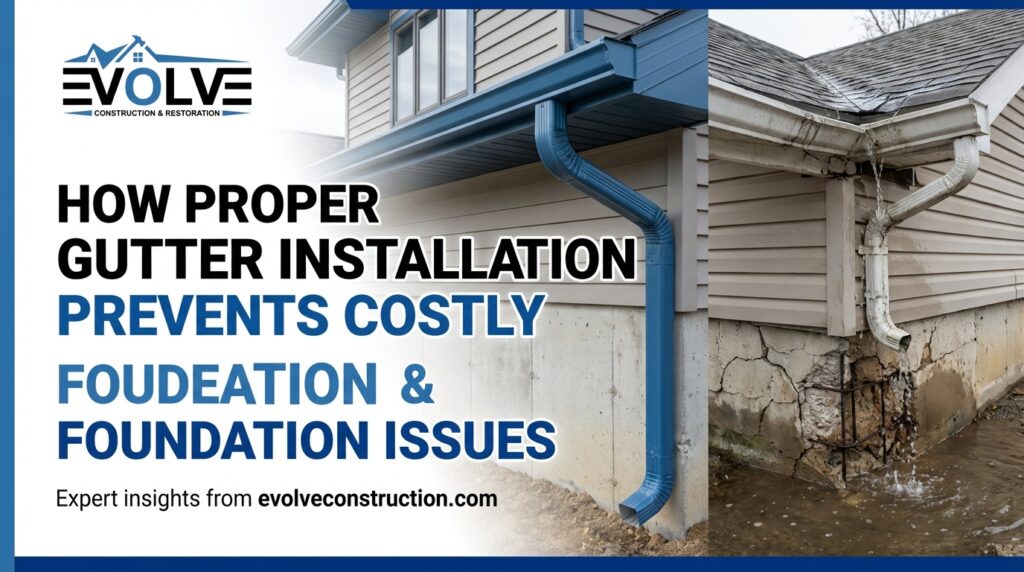
How Proper Gutter Installation Prevents Costly Foundation Issues
Your home is likely the largest investment you will ever make, and its stability rests entirely on the quality of its foundation. While most homeowners focus on aesthetic upgrades like new siding or interior renovations, the most critical component of structural health often hangs quietly along the roofline. Proper gutter installation is not merely a convenience for keeping your head dry during a storm; it is a sophisticated water management system designed to protect the very ground your house stands upon.
How does gutter installation protect your foundation?
Proper gutter installation prevents foundation issues by collecting roof runoff and directing it at least 5 to 10 feet away from the home. This prevents soil oversaturation, eliminates the buildup of hydrostatic pressure against basement walls, and stops soil erosion that leads to structural settling, cracking, and catastrophic shifting.
When gutters are missing, incorrectly sized, or poorly installed, they transform from a protective shield into a liability. Every inch of rain that falls on a standard 2,000-square-foot roof produces approximately 1,250 gallons of water. Without a functional system to divert this massive volume, that water falls directly against the base of your home, leading to a cascade of expensive structural failures. In this comprehensive guide, we will explore the science of water management and why precision in gutter installation is the ultimate insurance policy for your home.
1. The Science of Water: How Roof Runoff Becomes Foundation Pressure
To understand the necessity of proper gutter installation, one must first understand the physics of hydrostatic pressure. When water pools around your foundation due to gutter failure, it saturates the soil. This water-heavy soil exerts immense physical force against your foundation walls. This is known as hydrostatic pressure. Unlike the weight of dry soil, which foundation walls are designed to withstand, the weight of water-logged earth can exceed the structural tolerance of concrete blocks or poured concrete.
The Saturation Point and Wall Cracking
As the soil reaches its maximum saturation point, it begins to expand. In many regions, the soil consists of heavy clays that act like a sponge. When these clays absorb the thousands of gallons of water pouring off an unprotected roof, they expand outward and upward. This expansion pushes against the foundation walls with enough force to cause horizontal cracking, bowing, and eventually, structural collapse. Without gutters to move this water away, your home is essentially sitting in a muddy bathtub that is constantly pushing inward on your living space.
The Perils of Concentrated Runoff
When a gutter system is poorly installed—perhaps with the wrong pitch or insufficient capacity—it creates “water bombs.” This occurs when water overflows in concentrated streams rather than being distributed evenly. These concentrated streams can carve deep trenches into the soil at the base of your home, reaching the footings of the foundation much faster than natural rainfall ever could. This localized saturation creates uneven pressure, which is often more dangerous than uniform pressure because it causes the foundation to twist or torque.
2. Key Ways Proper Installation Protects Structural Integrity
The primary goal of proper gutter installation is to maintain the “structural equilibrium” of the soil surrounding your home. Foundation health is dependent on consistent moisture levels. When gutters fail, they create a cycle of extreme saturation followed by extreme drying. This cycle is the leading cause of foundation settling and shifting. By managing water effectively, gutters ensure that the soil remains stable and supportive throughout the year.
Preventing Soil Erosion
Soil erosion is a silent killer of foundations. As water cascades off a roofline without gutters, it physically carries away the topsoil and the compacted fill dirt that supports your foundation. Over time, this creates voids or “hollow spots” beneath the concrete footings. Once a footing loses its underlying support, the weight of the house causes that section of the foundation to drop or “settle.” This leads to uneven floors, doors that won’t close, and vertical cracks in the exterior brick or siding.
Maintaining Ground Stability
A professional gutter installation ensures that water is discharged in a controlled manner that does not disturb the grading of the yard. Most homes are built with a “positive grade,” meaning the land slopes away from the house. However, the force of water falling from a 20-foot roofline can quickly destroy this grade, turning a slope into a pit. By catching the water at the eaves, gutters preserve the integrity of your landscaping and the critical slope required to keep your basement dry.
3. The Critical Role of Downspout Extensions and Water Diversion
A gutter system is only as effective as its exit point. One of the most common mistakes in amateur gutter installation is neglecting the downspout discharge area. If your gutters collect water perfectly but dump it right at the corner of your foundation, you have essentially built a high-efficiency irrigation system for your basement. Proper gutter installation must include strategically placed downspout extensions to move the water to a safe distance.
The 5-to-10 Foot Rule
Industry standards dictate that downspouts should discharge water at least five feet away from the foundation for standard soil, and up to ten feet for homes built on expansive clay. This distance ensures that the discharged water enters the natural drainage pattern of the yard rather than seeping back toward the foundation wall. Professionals use a variety of tools to achieve this, including flip-up extensions, decorative splash blocks, or underground drainage pipes that lead to a dry well or a pop-up emitter at the curb.
Underground Drainage Integration
For properties with limited space or complex grading, integrating gutters into an underground drainage system is the gold standard. This involves connecting downspouts to PVC piping buried beneath the lawn. This system carries water completely away from the property’s “foundation zone.” This prevents the common issue of “re-circulation,” where water pumped out by a sump pump simply drains back into the foundation because the gutters are discharging too close to the house.
4. Beyond the Concrete: Preventing Pests, Mold, and Interior Water Damage
While the foundation is the primary concern, proper gutter installation also prevents secondary issues that can be just as costly. Moisture is a magnet for disaster. When water pools around a foundation, it creates a micro-climate that is ideal for pests and fungal growth. These issues often go unnoticed until they have caused thousands of dollars in damage to the wooden structure of the home.
Pest Prevention: Termites and Carpenter Ants
Subterranean termites and carpenter ants require high moisture levels to thrive. When gutters are clogged or missing, the soil around the foundation stays perpetually damp, providing the perfect highway for these pests to enter your home. Termites, in particular, will follow moisture trails directly into the sill plate—the wooden beam that sits on top of your foundation. Once they bridge the gap between the wet soil and your wooden frame, the structural integrity of your home is at severe risk.
Mold Remediation and Air Quality
Even if your foundation doesn’t crack, excessive moisture around the perimeter can lead to seepage through the porous concrete. Concrete is essentially a hard sponge; it can pull moisture from the outside into your basement or crawlspace through capillary action. This creates a damp environment where mold and mildew thrive. Beyond the smell, this can lead to serious respiratory issues for inhabitants and require professional mold remediation services that can cost upwards of $5,000.
5. Technical Precision: Why Pitch, Sizing, and Seamless Materials Matter
Gutter installation is a game of inches—or more accurately, fractions of an inch. A system that looks straight to the naked eye may actually be a failure in the making. Professionals focus on technical tolerances that ensure water moves quickly and efficiently, even during the most intense summer downpours or heavy spring snowmelts.
The 1/4 Inch Pitch Rule
For gutters to function, they must be pitched (sloped) toward the downspouts. The standard requirement is a 1/4-inch drop for every 10 feet of gutter run. If the pitch is too shallow, water will pool in the troughs, leading to rust, mosquito breeding, and sagging. If the pitch is too steep, the water may move too fast and overshoot the downspout opening or the corners. Getting this “perfect pitch” is the hallmark of proper gutter installation and is often the biggest hurdle for DIY attempts.
Seamless vs. Sectional Performance
Sectional gutters, often sold in big-box stores, are prone to leaking at the seams over time as the sealant degrades. Every leak in a gutter seam is a potential foundation problem in the making. Seamless gutters, on the other hand, are custom-fabricated on-site to the exact length of your home. With no seams between corners, the risk of leaks is virtually eliminated. This ensures that 100% of the water captured by the gutter actually reaches the downspout and is diverted away from the foundation.
6. Environmental Factors: Adapting Your Gutter Strategy to Local Soil and Climate
Not all gutters are created equal because not all environments are the same. A home built on the sandy soils of a coastal region faces different risks than a home built on the expansive clay of the Midwest or the rocky terrain of the North. Proper gutter installation must take these regional variations into account to provide adequate protection.
Expansive Clay vs. Sandy Soils
If you live in an area with expansive clay soil, your gutters are your foundation’s only hope. Clay soil expands significantly when wet and shrinks when dry. This constant movement can “rack” a foundation, leading to total structural failure. In these environments, water management must be aggressive, often requiring larger 6-inch gutters and oversized downspouts to handle heavy volumes. Conversely, in sandy soils, water drains quickly, but erosion is a higher risk, meaning splash blocks and controlled discharge are the primary focus.
Freeze-Thaw Cycles and Ice Dams
In colder climates, gutters must contend with ice. When snow melts on a roof and refreezes in the gutters, it forms an ice dam. This prevents further meltwater from entering the gutter, forcing it to back up under the shingles or spill over the side directly onto the foundation. Professional installers often recommend heat cables or specific gutter profiles in these regions to ensure that even in the dead of winter, the path to the downspout remains clear, preventing hydrostatic pressure buildup from winter snowmelt.
7. The ROI of Prevention: Analyzing Gutter Costs vs. Foundation Replacement
Many homeowners hesitate at the cost of high-quality, seamless gutters. However, when viewed through the lens of risk management, the investment is one of the most logical financial decisions you can make for your property. The cost of a proper gutter installation is a fraction of the cost of foundation repair. Let’s look at the numbers:
Service Type
Estimated Cost Range
Impact on Home Value
Professional Gutter Installation
$1,500 – $4,000
Increases value / Protects equity
Basement Waterproofing
$5,000 – $15,000
Corrective measure / High cost
Foundation Piering/Leveling
$10,000 – $40,000+
Recovery of value only / Major stigma
The financial logic is undeniable. A foundation repair involving hydraulic piers can easily cost $1,000 to $2,000 per pier, with many homes requiring 10 to 20 piers for a full stabilization. Furthermore, once a home has had foundation repairs, it must be disclosed during a sale, which can deter buyers and lower the selling price. Investing in gutters today prevents the structural “scarring” that devalues your home tomorrow.
8. Maintenance Checklist: Ensuring Long-Term Foundation Safety
Even the best proper gutter installation requires ongoing attention to remain effective. A gutter system is a dynamic part of your home’s exterior, subject to wind, debris, and temperature fluctuations. To ensure your foundation remains protected, follow this maintenance schedule to keep your water management system in peak condition.
- Bi-Annual Cleanings: Clean gutters every spring and fall. Even a small amount of debris can slow water flow and lead to the heavy overflows that damage foundations.
- The “Leaky Corner” Test: During a rainstorm, walk around your home. Look for water dripping from the corners or behind the gutter. This indicates a failed seal or improper pitch that needs immediate correction.
- Downspout Alignment Check: Ensure your extensions haven’t been knocked loose by lawnmowers or pets. A disconnected extension is the most common cause of sudden basement flooding.
- Gutter Guard Consideration: If your property has heavy tree cover, consider high-quality gutter guards. These reduce the risk of unexpected clogs between scheduled cleanings, providing 24/7 foundation protection.
Conclusion: Prioritizing Your Home’s First Line of Defense
The relationship between your roof and your foundation is managed entirely by your gutters. Proper gutter installation is the thread that holds the structural integrity of your home together. By understanding the science of hydrostatic pressure, the dangers of soil erosion, and the necessity of technical precision, you can move from reactive repairs to proactive protection. Don’t wait for a crack to appear in your basement wall or for your doors to start sticking to realize that your gutters aren’t doing their job.
Whether you are dealing with the aftermath of a major storm or simply looking to upgrade your home’s defenses, professional gutter services are an investment in peace of mind. By directing the power of the elements away from your home, you ensure that your foundation remains a solid, dry, and stable base for your family’s future.
Protect Your Foundation Today!
Our honest, friendly, and reputable professionals help homeowners and businesses maximize the value of their property and stand together with them to rebuild for a better tomorrow, especially after challenging storm events. Whether you need seamless gutters or a total restoration, we’re here to help.