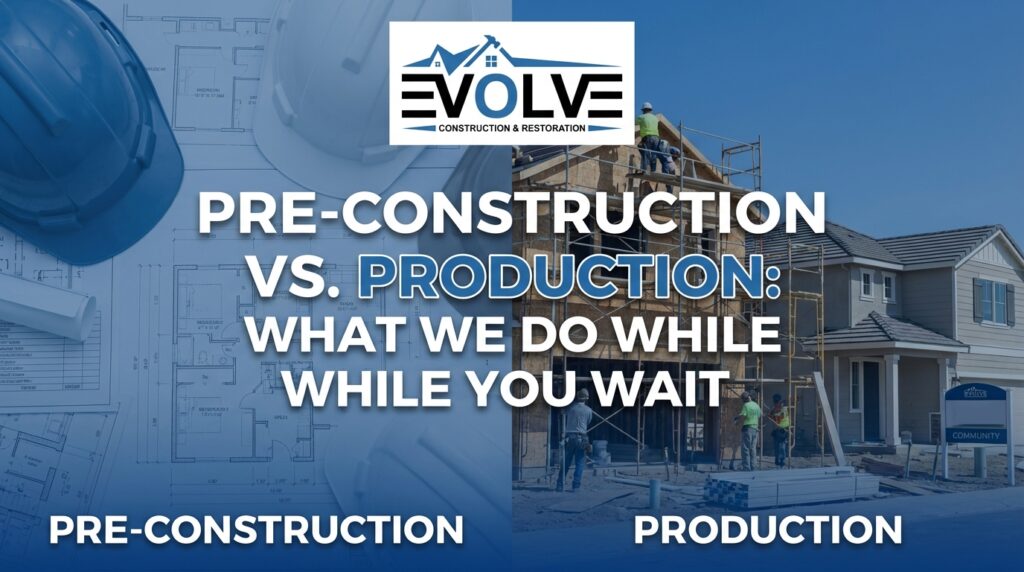
Pre-Construction Vs. Production: What We Are Doing While You Are Waiting
When you sign a contract for a major home improvement or restoration project, the excitement is palpable. You envision the new roof, the pristine siding, or the restored interior after a devastating storm. However, a common frustration often arises in the weeks following the initial deposit: the site remains quiet. To the untrained eye, it may look like nothing is happening. At Evolve Construction, we understand that this silence can lead to anxiety or even the false allegation that a contractor has taken a deposit without performing work. The reality, however, is that some of the most intensive, expert-level labor occurs long before a single nail is driven into a board.
This “invisible” phase is known as pre-construction. It is the period where we transition your project from a conceptual agreement into a buildable reality. During this time, our team is engaged in significant “administrative performance”—a legal and professional term for the essential work required to ensure your project is safe, legal, and built to last. This article will pull back the curtain on the pre-construction vs. production workflows, explaining exactly what is happening behind the scenes while you wait for the trucks to arrive.
1. Defining the Terms: Pre-Construction vs. Production Workflows
To understand why your project moves in phases, we must first define the two distinct halves of a construction project. Pre-construction is the strategic planning phase. It includes everything from site surveys and engineering to permitting and logistics. It is the foundation upon which the physical structure is built. Without a robust pre-construction phase, the actual build would be plagued by delays, code violations, and budget overruns.
The Planning Mindset
In pre-construction, our “tools” are computers, specialized software, and relationships with local building departments. We are refining the scope of work to ensure every detail matches the specific needs of your property. This phase requires a high degree of technical expertise, as we are often interpreting complex insurance adjustments, structural requirements, and local zoning laws to ensure the final product meets the highest standards of the International Code Council (ICC).
The Production Phase
Production, on the other hand, is the physical execution. This is the phase most homeowners are familiar with: the arrival of dumpsters, the delivery of materials, and the sound of hammers. While production is the most visible part of our work, it is actually the shorter of the two phases in many complex restoration projects. Production is the culmination of weeks or even months of meticulous pre-construction labor.
2. The ‘Black Hole’ Myth: Why No Action on Site Doesn’t Mean No Progress
A common misconception in the construction industry is that “work” only counts if it happens on the customer’s lawn. This leads to the unfortunate allegation that when a deposit is taken and no crew appears the next day, the contractor is “doing nothing.” In reality, the deposit initiates a series of high-cost, high-labor administrative tasks that are legally and professionally classified as administrative performance.
At Evolve Construction, your deposit is immediately put to work. It covers the costs of high-resolution aerial imaging, structural engineering fees, permit application costs, and the labor of dedicated project managers who spend hours navigating the bureaucracy of local government. This work is not only essential; it is billable labor that protects you, the homeowner. By defining this administrative labor as essential work, we emphasize that progress is being made daily, even if your doorbell isn’t ringing.
3. Behind the Scenes: 5 Critical Things We Are Doing While You Wait
While you are waiting for the production phase to begin, our team is completing several critical tasks that ensure the success of your project. These tasks are the backbone of our administrative performance and are required for every professional-grade construction project.
I. EagleView and Aerial Measurements
We use industry-leading technology like EagleView to obtain 3D aerial measurements of your property. This isn’t just a simple photograph; it is a highly accurate data set that tells us the exact pitch, square footage, and facet count of your roof or exterior. This ensures that we order the exact amount of material needed, preventing waste and ensuring your quote remains accurate.
II. Engineering Inputs and Structural Review
For many projects, especially those involving storm damage or structural changes, we must consult with licensed engineers. They provide the “engineering inputs”—the blueprints and calculations—required to ensure your home can withstand future high-wind events or heavy loads. This is particularly vital for our clients in coastal or storm-prone regions.
III. Material Procurement and Logistical Planning
We don’t just buy materials from the local big-box store. We work with specialized suppliers to source high-quality, professional-grade materials. This involves checking lead times for specific shingles, siding colors, or custom windows and securing your place in the supply chain queue.
4. The Regulatory Journey: Navigating Permits and Engineering Hurdles
One of the most significant “black holes” in construction timing is the permitting process. Every municipality has its own set of rules, and our project managers spend a significant portion of their week acting as your advocates at the building department. This is a critical part of the pre-construction phase that is entirely out of the builder’s control but requires constant management.
Permitting involves submitting our engineering plans, proof of insurance, and contractor licenses to the city or county. We then wait for a building official to review and approve the plans. In busy seasons—especially following a major storm event—building departments can become overwhelmed, leading to delays. During this time, Evolve Construction is “chasing” the permit, following up with clerks, and ensuring any requested revisions are handled immediately so your project doesn’t sit at the bottom of the pile.
5. Procurement Strategy: Why We Order Your Materials Months Before Framing
In the modern construction landscape, supply chain management is an art form. Waiting until the day before a project starts to order materials is a recipe for disaster. During the pre-construction phase, we implement a proactive procurement strategy. This is especially important for “long-lead” items like custom windows, specific roofing tiles, or high-end siding.
By ordering your materials early, we lock in pricing and availability. This protects you from the sudden price spikes that are common in the construction industry. Furthermore, it allows us to verify that the materials arriving at your home are exactly what was specified in the design phase. If a manufacturer has a delay, we find out during pre-construction, allowing us to pivot or update your timeline before your home is exposed to the elements.
6. How We Minimize Your Risks: Value Engineering and Subcontractor Bidding
Another vital aspect of our administrative performance is risk mitigation. We don’t just want to build your project; we want to build it efficiently and safely. This involves “Value Engineering.” During this process, our experts review the project plans to see if there are better, more cost-effective ways to achieve the same or better results. For example, we might suggest a specific underlayment that offers better storm protection for a lower price than a legacy product.
Additionally, we handle the subcontractor bidding and buyout process. We vet the specialized craftsmen—the electricians, the roofers, the painters—to ensure they meet our high standards for quality and safety. We coordinate their schedules so that when the production phase begins, the project moves like a well-oiled machine, with one trade following another in a logical, efficient sequence.
7. The ‘Shadow Work’ Reveal: A Day in the Life of a Project Manager
While the homeowner sees an empty driveway, the Evolve Project Manager (PM) is often working 10-hour days on “shadow work.” This is the invisible labor that keeps the project on track. A typical day during the pre-construction phase might include:
- 8:00 AM: Coordinating with the utility companies to mark underground lines (811 calls).
- 10:00 AM: Meeting with a structural engineer to clarify load-bearing requirements for a new porch.
- 1:00 PM: Driving to the county permit office to hand-deliver a revised site plan.
- 3:00 PM: Reviewing the latest material delivery schedules to ensure the supply chain is holding steady.
- 4:30 PM: Updating the digital project portal so the homeowner can see the latest administrative milestones.
This shadow work is the difference between a project that succeeds and one that fails. It is the labor of preparation that prevents the “cost of rushing,” which often manifests as expensive change orders or failed inspections later in the process.
8. Your Role in the Wait: How to Use This Time Productively
The pre-construction phase doesn’t have to be a period of passive waiting. There are several “homework” items that homeowners can complete to ensure a smooth transition into the production phase. Using this time productively can help alleviate the feeling of stagnation.
Finalize Your Aesthetics
Now is the time to visit showrooms or look at samples for colors and textures. Once the production phase starts, changes can be costly and cause major delays. Use the pre-construction window to finalize every choice, from the shingle color to the trim finish.
Prepare Your Property
Think about the logistics of having a construction crew at your home. Will you need to move patio furniture? Do you have pets that need to be secured? Preparing your space now saves stress later. Additionally, if your project involves interior work, you can begin “packing out” the affected areas to protect your belongings from dust and debris.
9. The Production Advantage: How Systems Shorten the Pre-Build Gap
At Evolve Construction, we use modern technology and refined systems to shorten the pre-construction gap as much as possible. While we cannot control the speed of a government permit clerk, we can control the speed of our internal processes. By using cloud-based management tools, we ensure that every member of our team—from the salesperson to the production manager—is working from the same real-time data.
These systems allow us to perform “Invisible Progress Updates.” Even when there is no dumpster in your driveway, you can log into our portal and see that the engineering has been approved or the material order has been confirmed. This transparency is our commitment to you, ensuring you know that your investment is being actively managed and that we are standing with you throughout the entire journey.
10. Conclusion: Transitioning from Planning to Breaking Ground
The transition from pre-construction to production is a major milestone. It is the moment when all the “shadow work,” administrative performance, and logistical planning finally manifest in physical form. When you see our crews arrive and the transformation of your property begins, remember that the speed and quality of that work are only possible because of the weeks of preparation that came before.
At Evolve Construction, we don’t just take deposits; we take responsibility. We understand that your home is your most valuable asset, and we treat the pre-construction phase with the same urgency and professionalism as the final day of construction. We aren’t just “waiting” for your project to start—we are working every single day to ensure that when it does start, it is done right the first time. Together, we can build a better tomorrow, starting with the invisible foundation of expert planning.
Ready to Get Started?
Our honest, friendly, and reputable professionals help homeowners and businesses maximize the value of their property and stand together with them to rebuild for a better tomorrow, especially after challenging storm events.