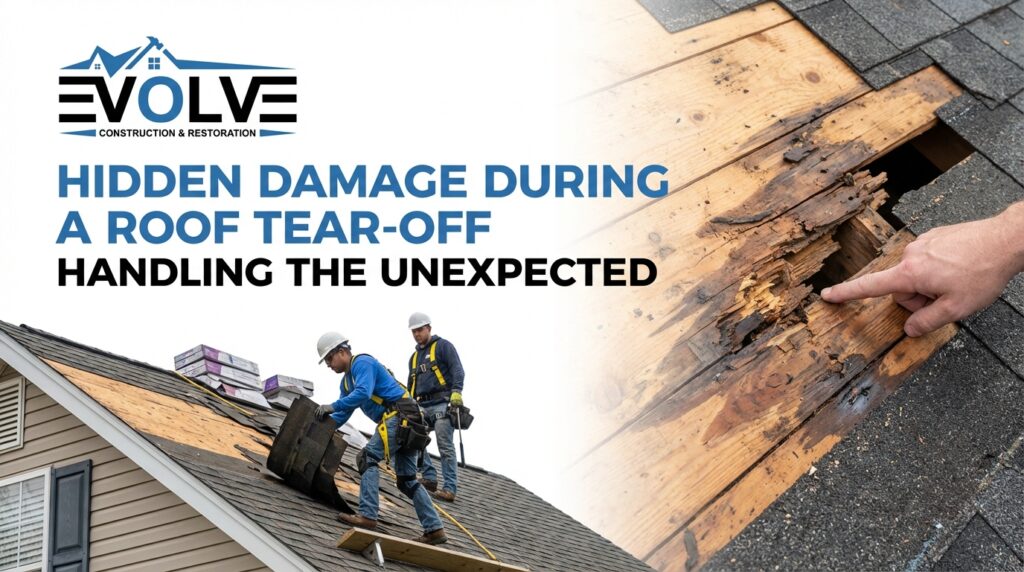
What Lies Beneath: Handling Hidden Damage During A Roof Tear-Off
When a roofing crew begins the process of a full tear-off, it is often referred to as the “moment of truth” for the home’s structural integrity. To the average homeowner, a roof replacement seems like a straightforward cosmetic and functional upgrade: old shingles come off, and new shingles go on. However, the reality of roofing is that the shingles you see are merely the outer skin of a complex protective system. What lies beneath those shingles—the decking, underlayment, flashing, and rafters—is what truly keeps your home safe and dry. Hidden damage during a roof tear-off is a common occurrence that can lead to project pauses and budget adjustments, often causing homeowners to feel anxious or even skeptical of their contractor’s honesty.
At Evolve Construction, we believe that transparency is the foundation of trust. If your project is paused because of discovered rot or structural decay, it is not an attempt to “upsell” or scam you; it is a professional commitment to ensuring your new roof doesn’t fail prematurely. Installing a 30-year architectural shingle over a rotting piece of plywood is like building a skyscraper on shifting sand. This guide explores why hidden damage happens, how we identify it, and the professional processes we use to manage these surprises without compromising your home or your budget.
What is a roof supplement? A supplement is a formal request for additional funds or materials sent to an insurance company when damage is discovered during the construction phase that was not visible during the initial adjuster’s inspection. Because adjusters cannot see through shingles, they often miss rotted decking or localized structural issues. A supplement ensures these vital repairs are covered, keeping the roof up to code and structurally sound.
The Hidden Risk of Overlays: Why Surface Inspections Aren’t Enough
In the roofing industry, there is a practice known as an “overlay,” where new shingles are simply nailed over the old ones. While this may seem like a cost-saving measure, it is arguably the most dangerous shortcut in home improvement. The primary reason Evolve Construction advocates for a full tear-off is that it allows for a comprehensive inspection of the roof deck. Without removing the old material, a contractor is essentially guessing at the condition of the wood beneath. A surface-level inspection, even with a drone or a ladder, can only reveal so much; it cannot detect the spongy texture of water-saturated plywood or the microscopic growth of mold within the wood fibers.
The Problem with Multiple Layers
When multiple layers of shingles are present, they trap heat and moisture. This creates a greenhouse effect that accelerates the decay of the wooden roof deck. By the time a leak is visible from the inside of your attic, the wood has likely been compromised for years. A full tear-off reveals these issues, allowing us to strip the system down to the bare “sheathing” to ensure the surface is flat, dry, and capable of holding a nail securely. If the nails don’t have solid wood to bite into, your new shingles could blow off in the first high-wind event.
Identifying “Spongy” Spots
During our pre-inspection, our technicians walk the roof to look for “soft spots.” These are areas where the deck feels like it gives underfoot. While this is a strong indicator of rot, it doesn’t tell the whole story. Sometimes, the rot is localized around a chimney or a vent, and other times it is widespread due to poor attic ventilation. Only a tear-off provides the visual confirmation needed to determine the exact square footage of the damage and the necessary scope of work for a permanent fix.
The ‘Big 5’ Hidden Issues: From Rotten Decking to Structural Rot
When the shingles are removed, five common issues frequently emerge. These aren’t just minor inconveniences; they are structural threats that must be addressed to maintain the manufacturer’s warranty and the safety of your property. Understanding these “Big 5” helps homeowners prepare for the technical realities of a roof replacement.
1. Wood Rot and Plywood Delamination
Plywood and OSB (Oriented Strand Board) are the most common decking materials. When exposed to moisture from leaks or high humidity, the glue holding the wood layers together fails, leading to delamination. Rotted wood becomes soft and crumbly, losing its load-bearing capacity. If we find more than a few sheets of rot, it usually points to a systemic failure in the old roofing system or the attic’s environmental controls.
2. Mold and Mildew Growth
Moisture trapped between shingles and the deck creates a breeding ground for mold. If mold is found on the top of the decking, it’s often a sign that the underlayment failed. If mold is found on the underside of the decking (visible from the attic), it indicates a ventilation problem where warm, moist air from the house is condensing on the cold wood. Addressing the wood is only half the battle; the ventilation must be corrected to prevent a recurrence.
3. Failing or Improperly Installed Underlayment
The underlayment is the secondary water barrier. Often, during a tear-off, we find that previous contractors used cheap organic felt paper that has become brittle and disintegrated over time. We also find “shiners”—nails that missed the rafters—which act as conduits for water to travel directly into your home. Modern synthetic underlayments are far superior, and seeing the failure of the old materials is often a wake-up call for homeowners to invest in higher-quality components.
4. Flashing and Sealant Degradation
Flashing is the metal used around chimneys, skylights, and valleys. It is often the first part of the roof to fail. During a tear-off, we frequently discover that the wood behind the flashing has completely rotted away because the metal was improperly layered or the sealant reached the end of its life. This is why Evolve Construction typically recommends replacing all flashing rather than trying to “save” old, corroded metal.
5. Pest Infestations and Structural Damage
In some cases, the “soft spot” isn’t caused by water alone. Termites, carpenter ants, and even rodents like squirrels can find their way into the roof structure through small gaps. Once inside, they can hollow out rafters or chew through sheathing. Discovering this during a tear-off is stressful, but it allows for immediate remediation before the damage spreads into the interior walls of your home.
The Anatomy of a Change Order: Managing the Financial Surprise
The most difficult part of discovering hidden damage is the conversation about cost. In the industry, this is handled through a “Change Order” or, in insurance-related cases, a “Supplement.” Many homeowners feel like they are being cornered when a contractor asks for more money once the roof is already stripped. To prevent this feeling of being scammed, it is essential to understand how these costs are calculated and why they are necessary.
The Contingency Fund Recommendation
At Evolve Construction, we recommend that every homeowner sets aside a contingency fund of roughly 10% to 15% of the total project cost. This isn’t because we expect to find problems, but because it is the responsible way to budget for an asset as complex as a roof. If the tear-off reveals a clean, healthy deck, you keep that money. If we find rot, the funds are already allocated, reducing the stress of the situation.
Contractual Transparency: The ‘Price per Sheet’ Clause
A reputable roofer will include a “Price per Sheet” or “Price per Linear Foot” clause in the initial contract for decking and fascia replacement. For example, your contract might state that the first two sheets of plywood are included, and every subsequent sheet is $95. This prevents price gouging. When hidden damage is found, the contractor should be able to point exactly to this clause so you know exactly what you are paying for without any “magic numbers” appearing on the final bill.
The Homeowner’s Guide to Auditing Damage: Photos, Proof, and Professionalism
How do you know if the roofer is telling the truth about the rot? You shouldn’t have to take their word for it. A professional roofing company will have a system in place to document everything they find in real-time. Because a roof replacement moves fast, this documentation is vital for both your peace of mind and for providing evidence to your insurance company.
Requesting Photo Documentation
At Evolve, our crews are trained to stop and take clear, high-resolution photos the moment they uncover damage. We take “wide” shots to show the location on the roof and “close-up” shots to show the severity of the rot or mold. If a contractor says you need 10 sheets of plywood but cannot produce 10 photos of the damaged areas, that is a red flag. We believe in showing, not just telling.
The Physical Inspection
If you are physically able and it is safe to do so (with proper supervision), you can ask to see the damaged wood that has been removed. Examining the removed material allows you to see the delamination or rot firsthand. Furthermore, we often invite homeowners to look up into the attic if the decking has been removed; seeing the light through the gaps where the rot used to be is a powerful way to understand the necessity of the repair.
Essential Repairs: When to Patch vs. When to Replace the Roof Deck
Not all damage requires a full overhaul. Part of Evolve Construction’s commitment to honesty is determining the most cost-effective way to ensure structural integrity without overcharging for unnecessary materials. There is a fine line between a localized patch and a systemic replacement, and the criteria for each are based on engineering standards and local building codes.
Criteria for Replacing a Sheet of Decking
We replace decking if any of the following are true: 1) The wood is soft or “punky” to the touch. 2) There is visible black mold growth on the surface. 3) The plywood is delaminating (layers are peeling). 4) The wood is warped or “cupping,” which will prevent the new shingles from laying flat. Even if the wood is dry today, if it has been wet in the past, its structural capacity is permanently reduced.
The Problem with “Patching” Small Holes
Sometimes we find small holes from old vents or minor localized rot. While it might be tempting to just put a small piece of wood over the hole, this creates an uneven surface. For a roof to be warrantied, the decking must be a continuous, smooth surface. We typically replace the entire 4×8 sheet of plywood even if the damage is only in one corner, as this ensures the edges of the wood align perfectly with the rafters for maximum strength.
Beyond the Deck: Checking Rafters, Insulation, and Attic Ventilation
A roof replacement is the perfect time to perform a “health check” on the entire upper envelope of your home. When the deck is removed, we get a bird’s eye view into your attic that is often more revealing than an inspection from the inside. We look for issues that could sabotage your new roof if left unaddressed.
Sistering Rafters vs. Full Replacement
If the water damage has reached the rafters (the bones of your roof), it becomes a structural issue. In many cases, we can “sister” a rafter—nailing a new, healthy piece of lumber alongside the damaged one to reinforce it. However, if the rafter is completely rotted through or infested with wood-boring insects, a full replacement may be required. This is a critical safety repair that should never be ignored.
The Ventilation Audit
Many “hidden” issues are caused by poor attic ventilation. If we find systemic mold, we will evaluate your intake (soffit) and exhaust (ridge) vents. If the attic is too hot, it “bakes” the shingles from the inside out. We use this opportunity to upgrade your ventilation system, ensuring that the new roof foundation stays dry and cool, which can significantly extend the lifespan of your shingles and lower your energy bills.
Preventing the Next Surprise: Upgrades to Protect Your New Roof Foundation
Once the repairs are made and the deck is solid, the goal is to make sure you never have to deal with hidden damage again. The choices made during the reconstruction phase determine how well the roof will handle the next twenty years of rain, ice, and sun. We recommend several upgrades that act as insurance for your roof deck.
Synthetic Underlayment and Ice/Water Shields
Standard felt paper is a relic of the past. We use high-performance synthetic underlayments that are virtually untearable and provide a much better moisture barrier. In addition, we install “Ice and Water Shield” in all critical areas like valleys, eaves, and around penetrations. This self-adhering membrane creates a watertight seal around every nail that passes through it, specifically preventing the type of rot that typically hides under shingles.
Drip Edge Installation
A “drip edge” is a metal flashing installed at the edges of the roof. It directs water away from the fascia and into the gutters. Many older roofs lack a drip edge, which leads to the edges of the plywood rotting. By installing a high-quality drip edge, we protect the perimeter of your roof deck from the “wicking” effect of water that can cause hidden damage over time.
Conclusion: Investing in the Foundation for Long-Term Roof Health
Discovering hidden damage during a roof tear-off is never a pleasant experience, but it is an essential one. While the pause in work and the increase in cost can be frustrating, these actions are the mark of a contractor who cares more about the longevity of your home than just finishing a job quickly. At Evolve Construction, we see ourselves as your advocates. Our goal is to uncover the truth about your roof’s condition so that we can fix it correctly the first time.
By addressing wood rot, mold, and structural issues during the tear-off phase, we ensure that your new roof is backed by a solid foundation. This not only protects your financial investment but also ensures the safety and comfort of everyone inside the building. Remember, the best roof in the world is only as good as the wood it’s nailed to. Together, we can build a better, stronger tomorrow by making sure your roof is healthy from the inside out.
Ready to Get Started?
Our honest, friendly, and reputable professionals help homeowners and businesses maximize the value of their property and stand together with them to rebuild for a better tomorrow, especially after challenging storm events. Whether you need a thorough inspection or a full replacement, we are here to guide you through every step of the process with transparency and expertise.