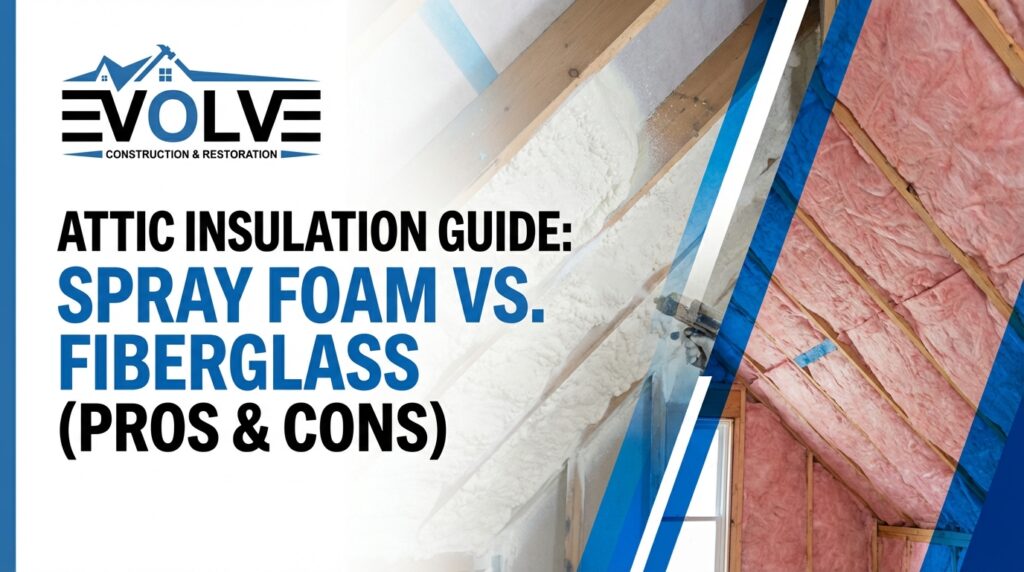
Attic Insulation Guide: Spray Foam vs. Fiberglass
When it comes to home improvement, few projects offer a higher return on investment than upgrading your attic insulation. It is the invisible barrier that stands between your family and the sweltering heat of summer or the biting chill of winter. However, for many homeowners, the choice between spray foam and fiberglass can feel overwhelming. This comprehensive guide breaks down the science, the costs, and the long-term benefits of each material to help you make an informed decision for your property.
At Evolve Construction, we believe that transparency is the foundation of a successful project. Whether you are rebuilding after a major storm or simply looking to slash your monthly utility bills, understanding the nuances of building science is key. This guide explores the critical differences between traditional fiberglass batts and high-performance spray foam insulation, ensuring you choose the solution that fits your budget and your home’s unique structural needs.
Which is better: Spray Foam or Fiberglass?
The choice depends on your goals: Spray foam provides a superior air seal and higher R-value per inch, making it ideal for maximum energy efficiency and unvented attics. Fiberglass is a cost-effective, time-tested material best suited for budget-conscious projects in traditionally vented attics. While spray foam has a higher upfront cost, it often yields greater long-term savings through lower HVAC demands.
1. Introduction: Why Attic Insulation is the Highest-ROI Home Improvement
Many homeowners focus on visible upgrades like new countertops or hardwood floors, but the most impactful change you can make to your home’s comfort and value happens in the attic. According to the EPA’s Energy Star program, homeowners can save an average of 15% on heating and cooling costs by air sealing and insulating their attics. This isn’t just about monthly savings; it is about extending the lifespan of your HVAC system and protecting your roof structure from moisture damage.
Attic insulation acts as the thermal envelope of your home. In the summer, it prevents the sun’s radiant heat from baking your living spaces. In the winter, it keeps the expensive warm air produced by your furnace from escaping through the ceiling. Without proper insulation, your home essentially acts like a chimney, constantly losing energy and forcing your mechanical systems to work overtime, leading to premature equipment failure.
Beyond energy savings, high-quality insulation increases your home’s resale value. Modern buyers are increasingly savvy about energy audits and utility costs. A well-insulated attic is a major selling point that signifies a well-maintained home. Furthermore, in regions prone to extreme weather, the right insulation can prevent ice dams and reduce the risk of mold growth, providing a safer environment for your family.
2. The Contenders: Understanding Spray Foam and Fiberglass Materials
Fiberglass Insulation: The Traditional Choice
Fiberglass has been the industry standard for decades. It is composed of extremely fine glass fibers and is typically sold in two forms: batts (pre-cut blankets) and blown-in (loose-fill). It works by trapping small pockets of air to slow the transfer of heat. Modern fiberglass often contains up to 40-60% recycled glass content, making it a relatively sustainable choice for those looking to minimize their environmental footprint.
Spray Foam Insulation: The High-Performance Alternative
Spray Polyurethane Foam (SPF) is a chemical product created by mixing two components (often referred to as ‘Side A’ and ‘Side B’) that expand upon contact with a surface. There are two primary types: Open-Cell and Closed-Cell. Open-cell foam is softer and more flexible, while closed-cell foam is rigid and incredibly dense, often adding structural integrity to the roof deck itself.
The primary differentiator for spray foam is its ability to expand into every nook and cranny. While fiberglass sits on top of surfaces, spray foam adheres to them, creating a seamless monolithic barrier. This characteristic allows it to perform two roles at once: it provides thermal resistance (insulation) and acts as an air barrier, which is something fiberglass cannot do on its own.
3. Performance Deep Dive: R-Value, Air Sealing, and Thermal Bridges
The most common metric for insulation is R-value, which measures the material’s resistance to heat flow. However, R-value only tells part of the story. Fiberglass batts typically offer an R-value of about 3.0 to 3.7 per inch. Blown-in fiberglass ranges from 2.2 to 2.7 per inch. While these numbers are respectable, fiberglass is prone to “wind washing” and air infiltration, which can significantly degrade its effective R-value in the real world.
In contrast, spray foam offers much higher performance density. Open-cell foam provides roughly R-3.5 to R-3.8 per inch, while closed-cell foam can reach a staggering R-6.5 to R-7.0 per inch. Because spray foam creates an airtight seal, it eliminates the convection currents that often bypass fiberglass insulation. It effectively stops drafts and prevents “thermal bridging”—the process where heat travels through the wooden studs and rafters of your home.
Consider this comparison table for a standard 2×6 rafter space:
Fiberglass Batts
3.1 – 3.4
No
No
Open-Cell Spray Foam
3.5 – 3.8
Yes
No (Vapor Permeable)
Closed-Cell Spray Foam
6.5 – 7.0
Yes
Yes (Vapor Barrier)
4. Building Science: Vented vs. Unvented Attic Assemblies
One of the most significant differences between these two materials is how they change the building science of your attic. Traditional fiberglass is installed on the “floor” of the attic. This creates a vented attic, where the attic space remains the same temperature as the outside air. While effective, this means any HVAC ductwork located in your attic is sitting in a 130-degree environment in the summer, forcing it to work much harder to deliver cool air.
Spray foam allows for the creation of an unvented or “conditioned” attic. By applying spray foam directly to the underside of the roof deck, you move the thermal envelope from the floor to the roofline. This brings the attic space into the conditioned volume of the home. The attic temperature will typically stay within 10 degrees of your living room, drastically reducing the load on your HVAC system and protecting stored belongings from extreme heat and humidity.
This shift in building science also impacts moisture management. In a vented attic, moisture from the house can sometimes condense on cold roof surfaces, leading to mold. In a spray foam attic, the airtight seal prevents humid air from reaching the cold roof deck, virtually eliminating condensation risks when installed correctly by a professional crew like Evolve Construction.
5. The Cost Equation: Detailed Breakdown of Materials and Labor
There is no sugar-coating it: spray foam is more expensive upfront. On average, spray foam insulation can cost 2 to 4 times as much as fiberglass. Fiberglass batts are relatively inexpensive, often costing between $0.40 and $1.10 per square foot for materials. Blown-in fiberglass is similarly priced, making it the go-to option for homeowners on a tight budget or those looking for a quick fix before selling a property.
Spray foam costs are higher due to the chemical components and the specialized equipment required. Open-cell foam typically ranges from $1.20 to $1.80 per board foot (a board foot is 12″x12″x1″), while closed-cell foam can range from $2.00 to $3.50 per board foot. Because a full attic often requires several inches of thickness to meet local building codes, the total investment for a standard 2,000 sq. ft. attic can range from $5,000 to $12,000, compared to $1,500 to $3,500 for fiberglass.
However, the material cost is only part of the story. One often overlooked factor is HVAC downsizing. Because spray foam creates such a tight seal, you may be able to install a smaller, less expensive HVAC unit when it comes time for replacement. A smaller 3-ton unit can sometimes replace a 5-ton unit in a foam-insulated home, potentially saving you thousands of dollars on the mechanical side of the house, which helps offset the insulation’s initial price tag.
6. ROI & Payback Periods: Calculating Energy Savings by Climate Zone
The return on investment (ROI) for insulation varies significantly based on your geography. In “Hot-Humid” regions like the Gulf Coast or Florida, the payback period for spray foam is shorter because the air conditioning runs nearly year-round. Homeowners in these areas often see a 20-40% reduction in their monthly cooling bills after switching from fiberglass to spray foam, leading to a full payback in roughly 5 to 7 years.
In “Cold” regions, the focus shifts to heat retention. While fiberglass performs well in cold climates, it is susceptible to convective loops—where warm air rises through the insulation, hits the cold roof, and circles back down. Spray foam stops this cycle entirely. In climate zones 5 through 7, the energy savings are substantial, though the higher cost of closed-cell foam (often required for its vapor barrier properties in the north) may extend the payback period to 8 or 10 years.
From a real estate appraisal perspective, energy efficiency is often viewed as a “marketability plus” rather than a dollar-for-dollar increase in formal home value. While a bank appraiser might only add a few thousand dollars for high-end insulation, the actual value realized during the sale is often much higher. Homes with lower utility bills sell faster and often command higher closing prices because buyers view them as “worry-free” properties with lower carrying costs.
7. Health and Sustainability: VOCs, Recycled Content, and Indoor Air Quality
Indoor air quality (IAQ) is a major concern for modern families. Fiberglass is often criticized for the potential of shedding tiny glass fibers into the air, which can irritate the lungs and skin. However, modern fiberglass is manufactured with formaldehyde-free binders and is Greenguard Gold certified for low chemical emissions. If your attic is properly sealed from the living space, fiberglass presents minimal health risks.
Spray foam is a chemical product, and during the application process, it off-gasses Volatile Organic Compounds (VOCs). Homeowners must typically vacate the premises for 24 hours while the foam cures. However, once cured, high-quality spray foam is inert and does not off-gas. In fact, because spray foam creates a superior air seal, it can actually improve IAQ by preventing outdoor pollutants, allergens, and dust from entering the home through the attic.
Regarding sustainability, fiberglass wins on recycled content, utilizing post-consumer glass. Spray foam, however, has traditionally used blowing agents with high Global Warming Potential (GWP). The good news is that the industry is shifting. Many modern spray foams now utilize HFO (hydrofluoroolefin) blowing agents, which have a GWP of 1—meaning they are much friendlier to the ozone layer than the older HFC-based foams.
8. The ‘Flash and Batt’ Alternative: The Best of Both Worlds?
For homeowners who want the benefits of spray foam but are working with a fiberglass budget, the “Flash and Batt” method is an excellent hybrid solution. In this process, a professional installer applies a thin layer (typically 1 to 2 inches) of closed-cell spray foam directly to the roof deck or wall cavity. This “flash” layer serves as the primary air seal and vapor barrier, stopping drafts in their tracks.
The remaining cavity space is then filled with standard fiberglass batts or blown-in insulation. This allows you to achieve a high total R-value at a fraction of the cost of a full spray foam install. You get the air-sealing benefits of the foam and the low-cost bulk of the fiberglass. It is a common strategy in mid-range remodeling projects where performance and budget must be carefully balanced.
However, “Flash and Batt” must be done carefully. If the foam layer is too thin in cold climates, the “dew point” can occur inside the fiberglass layer, leading to moisture accumulation against the foam. This is why working with an experienced contractor like Evolve Construction is vital; we understand the local climate zones and ensure the ratios are correct to prevent moisture issues.
9. Installation Guide: What to Expect from a Professional Crew vs. DIY
Can you DIY your attic insulation? For fiberglass, the answer is often yes. Many homeowners successfully install fiberglass batts or rent a blower for loose-fill insulation. However, it is a dirty, itchy, and physically demanding job. Common DIY mistakes include blocking soffit vents (which causes mold) or failing to air-seal the attic floor before laying down the insulation, which negates much of the benefit.
Spray foam is not a DIY project. The chemicals must be heated to specific temperatures and maintained at precise pressures to ensure a proper reaction. If the mix is off by even a small percentage, the foam may not cure correctly, leading to lingering odors or a lack of adhesion. Professional crews use specialized PPE, including fresh-air respirators, and have the training to ensure the foam reaches every hidden bypass and top plate in the attic.
When you hire a professional crew, you are paying for more than just the material. You are paying for a comprehensive energy assessment. At Evolve Construction, our team doesn’t just spray and leave. We inspect for existing roof leaks, check for proper ventilation (if using a vented system), and ensure that all light fixtures and electrical boxes are handled safely to prevent fire hazards. We take the guesswork out of the process, ensuring your home meets or exceeds local building codes.
10. Final Verdict: How to Choose Based on Budget and Home Longevity Goals
Choosing between spray foam and fiberglass ultimately comes down to your long-term goals. If you plan on staying in your home for 10+ years and want the ultimate in comfort and efficiency, spray foam is the clear winner. It transforms your attic into a clean, conditioned space and offers the best protection against the elements. If you are on a strict budget or preparing a home for a quick sale, fiberglass provides a solid, reliable improvement at a much lower price point.
At Evolve Construction, we understand that trust is the most important part of any home improvement project. Many companies are “storm chasers” who disappear once the check clears. We are different. As a large, established company with physical headquarters, we will be here to honor our warranties long after the storm has passed. We don’t just provide a manufacturer’s warranty, like the prestigious GAF Golden Pledge (which covers materials and labor for up to 50 years on roofing); we also provide Evolve’s own 100% Satisfaction Guarantee.
Our commitment to the community means we stand behind every square inch of insulation we install. We treat your home as if it were our own, ensuring that the work is done right the first time. If you’re ready to stop wasting money on energy bills and start building a more comfortable future for your family, we are here to help you every step of the way.
Ready to Get Started?
Our honest, friendly, and reputable professionals help homeowners and businesses maximize the value of their property and stand together with them to rebuild for a better tomorrow, especially after challenging storm events.