Safeguarding Your Restoration Funds: How Multi-Party Checks Protect Homeowners
Recovering from a major property loss—whether due to a devastating hail storm, a house fire, or internal water damage—is an emotionally taxing journey. The arrival of an insurance settlement check should be a moment of relief, yet for many homeowners, seeing multiple names on that check triggers immediate confusion and anxiety. You might see your name alongside your mortgage lender and perhaps even your contractor. This document, known as a multi-party insurance check, is not a bureaucratic hurdle designed to slow you down. Instead, it is a sophisticated financial safeguard rooted in banking regulations and insurance standards intended to protect your most significant investment.
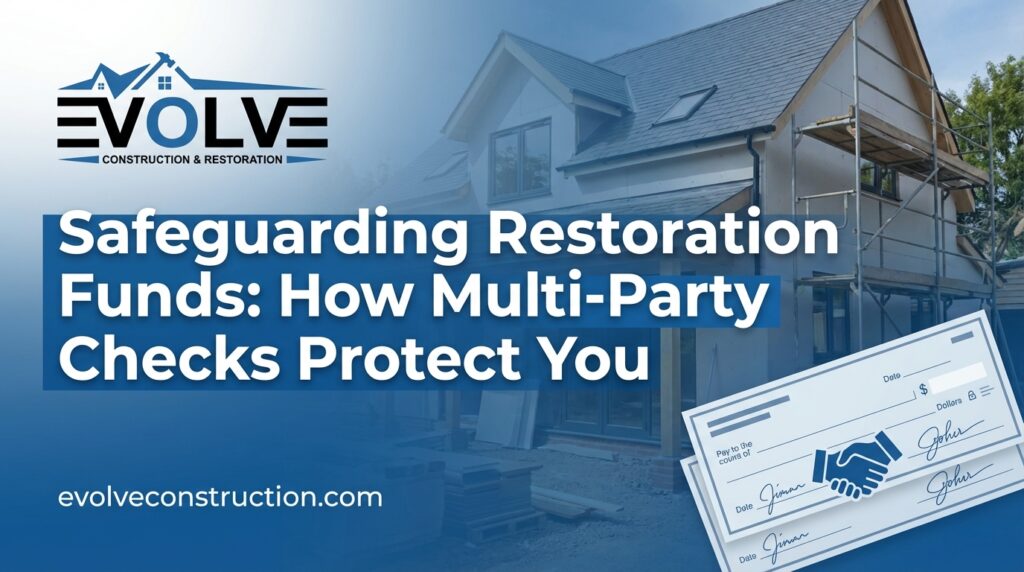
What are multi-party insurance checks? These are settlement payments issued by insurance carriers that require the endorsement of all listed parties—typically the homeowner and the mortgage servicer—before funds can be accessed. This process, often called the “loss draft” process, ensures that insurance proceeds are used specifically for property restoration, safeguarding the lender’s collateral while protecting the homeowner from fraudulent contractor practices and ensuring the work meets professional standards.
1. Navigating the Complexity of Post-Disaster Restoration Funds
The aftermath of a natural disaster is often a breeding ground for misinformation. Homeowners hear horror stories about “intercepted insurance money” or “stolen funds,” leading to a high-stress environment where every financial delay feels like a potential catastrophe. However, the reality of the insurance claim environment is far more secure than the rumors suggest. The financial industry has developed rigorous protocols to ensure that the tens of thousands of dollars allocated for your roof or kitchen restoration don’t simply vanish into thin air.
The Psychology of Financial Security
Understanding that these funds are held in specialized trust accounts or escrow can significantly reduce homeowner anxiety. When you realize that your mortgage company has a vested interest in seeing your home restored to its original (or better) condition, you begin to see them as a partner in the quality control process rather than an obstacle. This structural oversight acts as a “second set of eyes,” ensuring that the money is paid out only as work is verified and completed.
Countering Fraud Claims
Claims of “fraudulent cashing” are remarkably rare in the modern banking system because of multi-party requirements. Because the check requires multiple endorsements, it is virtually impossible for a third party to intercept and cash the check at a standard retail bank. This multi-layered verification is the first line of defense in safeguarding your restoration funds against identity theft or contractor malfeasance.
2. The Multi-Party Check: What It Is and Why It Lists Your Mortgage Company
When you look at your insurance check, you will likely see your name followed by the word “AND” and the name of your mortgage lender. This is not a suggestion; it is a legal requirement. Because your mortgage company holds a lien on your property, they have a “beneficial interest” in the asset. If the home is damaged, the value of their collateral decreases. To ensure their investment remains sound, they must oversee the application of insurance funds to the physical structure.
The Crucial Difference Between ‘And’ and ‘Or’
In the world of negotiable instruments, a single word changes everything. If a check is made out to “John Doe OR Mortgage Bank,” either party can endorse and cash it. However, insurance standards almost exclusively use “AND.” This means every party listed must sign the back of the check. This prevents one party from taking the funds without the knowledge or consent of the other, creating a system of checks and balances that keeps all stakeholders informed.
The Role of the Adjuster
Sometimes, an independent adjuster’s name or a public adjuster’s firm may also appear on the check if they were contracted to represent you. This further complicates the endorsement process but ensures that the professional who negotiated your settlement is compensated according to your agreement, preventing legal disputes later in the restoration process.
3. Protecting Your Assets: How Multi-Party Checks Act as a Safeguard Against Contractor Fraud
One of the most significant risks after a storm is the influx of “fly-by-night” contractors—unlicensed individuals who travel to disaster zones, collect large down payments, and disappear before finishing the work. Multi-party checks are the most effective tool in the industry for neutralizing this threat. Since the homeowner and the lender must both approve the release of funds, a contractor cannot simply walk away with the full claim amount on day one.
Escrow as a Safety Net
When the mortgage company receives the insurance check, they don’t simply keep the money. They place it in a restricted escrow account, often called a “loss draft account.” This money is legally yours, but it is held in trust. This arrangement ensures that the contractor is paid for the work they actually perform, providing the homeowner with immense leverage. If a contractor performs substandard work, the homeowner can request that the lender withhold the next disbursement until the issues are corrected.
The Red Flag of Assignment of Benefits (AOB)
Some contractors may ask you to sign an “Assignment of Benefits” (AOB). This legal document transfers your insurance rights and claim payments directly to the contractor. While common in some regions, AOBs can be risky because they remove the homeowner from the financial loop. By sticking to the multi-party check process, you maintain control over your restoration funds and ensure you have the final say in whether a job is completed to your satisfaction.
4. The $40,000 Threshold: Identifying if Your Claim is Monitored or Non-Monitored
Not all insurance claims are treated with the same level of scrutiny. Mortgage lenders, following guidelines from entities like Fannie Mae and Freddie Mac, typically categorize claims into two groups: monitored and non-monitored. The common industry threshold for this distinction is $40,000, though this can vary slightly depending on your specific lender and the current status of your mortgage payments.
Non-Monitored Claims (Under $40,000)
If your claim is relatively small—perhaps a minor roof repair or a small kitchen leak—the lender may consider it “non-monitored.” In these cases, the lender will typically endorse the check and hand it back to you immediately, trusting you to manage the repairs yourself. This is designed to reduce administrative overhead for smaller projects where the risk to the property’s total value is minimal.
Monitored Claims (Over $40,000)
Claims exceeding $40,000 (or those where the homeowner is currently delinquent on mortgage payments) are almost always “monitored.” For these larger investments, the lender will take an active role. They will require specific documentation, perform inspections at various stages of completion, and release funds in increments. This rigorous oversight is what truly safeguards your restoration funds during a massive rebuild.
5. Step-by-Step Guide: How to Secure Your Mortgage Company’s Endorsement
Securing an endorsement from a large national bank can feel like sending a message into a black hole if you don’t follow the correct procedure. Most major lenders like Chase, Wells Fargo, and Bank of America have dedicated “Loss Draft Departments” specifically trained to handle these checks. You should never simply mail a check to your standard mortgage payment address without prior authorization.
- Contact the Loss Draft Department: Call your lender immediately and ask for the loss draft department. They will provide you with a specific claim number and a mailing address for the check.
- Endorse the Check First: As the homeowner, you must sign the check before sending it to the lender. If there are two names on the mortgage (e.g., you and a spouse), both must typically sign.
- Send via Certified Mail: Never send a $50,000 check via regular mail. Use a tracked service (FedEx, UPS, or USPS Certified) so you have proof of delivery.
- Verify Receipt: Most lenders now offer online portals where you can track the status of your “loss draft” and see when the check has been received and processed.
6. The Essential Paperwork Checklist: Everything You Need for the Loss Draft Department
To release the first portion of your funds, the lender needs to verify that the money is going to a legitimate project handled by a legitimate professional. Having this paperwork ready before you call can shave weeks off your restoration timeline. The lender’s primary goal is to verify that the scope of work matches the insurance company’s estimate.
Adjuster’s Summary
The itemized list from the insurance company showing what they are paying for.
Signed Contract
Your formal agreement with a contractor like Evolve Construction.
Contractor’s W-9
Required for tax reporting and verifying the contractor’s business status.
Contractor’s License & Insurance
Proof that the contractor is authorized to work in your area.
Conditional Waiver of Lien
A document stating the contractor won’t place a lien on your home once paid.
7. The Release Schedule: Understanding Incremental Disbursements and Completion Milestones
For monitored claims, the lender will not release the full amount of the insurance check at once. This is the core mechanism of safeguarding your restoration funds. Instead, they follow a disbursement schedule—often a “33/33/33” or “50/50” model—to ensure the project stays on track and the funds are actually being used for materials and labor.
Initial Disbursement (The Deposit)
The first draw is typically 25% to 50% of the total claim. This allows the contractor to order materials and mobilize their crew. This initial release is usually triggered simply by the lender receiving the endorsed check and the signed contract. It provides the momentum needed to start the restoration without exposing the entire fund to risk.
Progress Payments and Inspections
As the work hits the 50% mark, the lender may require a “Progress Inspection.” They will send a third-party inspector to your home to verify that the roof is half-installed or the drywall is up. Only after the inspector confirms the progress will the next disbursement be released. This prevents a scenario where a homeowner pays for a whole roof but only receives half of one.
Final Disbursement and Certificate of Completion
The final 10% to 33% (the “retainage”) is held until the job is 100% complete. You and your contractor must sign a “Certificate of Completion,” and a final inspection is usually conducted. This ensures that the finishing touches—the gutters, the painting, the debris cleanup—are actually done before the contractor receives their final payment.
8. Proactive Communication: Tips for Managing Your Lender and Contractor Simultaneously
The secret to a smooth restoration process is transparency. You are the bridge between a massive financial institution (the lender) and a local service provider (the contractor). If communication breaks down, the project stalls. Proactive homeowners who manage this relationship effectively often see their projects completed weeks faster than those who take a passive approach.
Set up a three-way introductory call if possible, or at least ensure your contractor has the contact information for your loss draft representative. Experienced contractors like those at Evolve Construction are familiar with these requirements and can often handle the heavy lifting of documentation for you. By authorizing your contractor to speak with your lender’s loss draft department, you can streamline the inspection scheduling and document submission process.
9. Modern Solutions: How Digital Endorsement Tools are Slashing Restoration Wait Times
In the past, the loss draft process was synonymous with “snail mail” delays. Fortunately, the industry has moved toward digital solutions. Many lenders now use platforms like PropertyClaimCenter.com or their own proprietary mobile apps that allow for digital endorsement and remote check capture. This can reduce the “float” time of your money from weeks to just a few days.
Digital tools also allow for “Virtual Inspections.” Instead of waiting for a physical inspector to drive to your home, contractors can sometimes upload geo-tagged, time-stamped photos of the progress through a secure portal. This technology is a game-changer for safeguarding restoration funds because it provides a verifiable, digital trail of the work performed, making it much harder for fraudulent claims to go undetected.
10. Troubleshooting Delays: What to Do When Funds Are Stuck in Escrow
Despite the best safeguards, delays can happen. Perhaps the lender is demanding a document that doesn’t exist, or the inspector is backlogged. If your funds are stuck and your restoration has ground to a halt, you have legal and regulatory recourse. Lenders are legally required to handle these funds in good faith; they cannot “unreasonably” withhold money that is rightfully yours for repairs.
If you encounter a stalemate, start by requesting a supervisor in the loss draft department. If that doesn’t work, you can file a complaint with the Consumer Financial Protection Bureau (CFPB) or your state’s Insurance Commissioner’s office. Most lenders will move very quickly once a federal or state inquiry is initiated. Additionally, your credit score is generally not impacted by these escrow accounts, so you don’t need to fear financial repercussions for the duration of the claim process.
Conclusion: Leveraging Safeguards to Ensure a Successful Home Restoration
While the sight of multiple names on your insurance check might initially feel like a hurdle, it is actually the ultimate safety net for your home. By involving your mortgage lender, the financial system ensures that your restoration funds are protected from fraud, that your contractor is held accountable for their work, and that your home is restored to its full value. When you work with a reputable partner like Evolve Construction, we stand with you throughout this entire process, helping you navigate the paperwork and communication required to get your home—and your life—back to normal.
Ready to Restore Your Home?
Our honest, friendly, and reputable professionals help homeowners and businesses maximize the value of their property and stand together with them to rebuild for a better tomorrow, especially after challenging storm events. We have extensive experience navigating the insurance and loss draft process to make your restoration seamless.