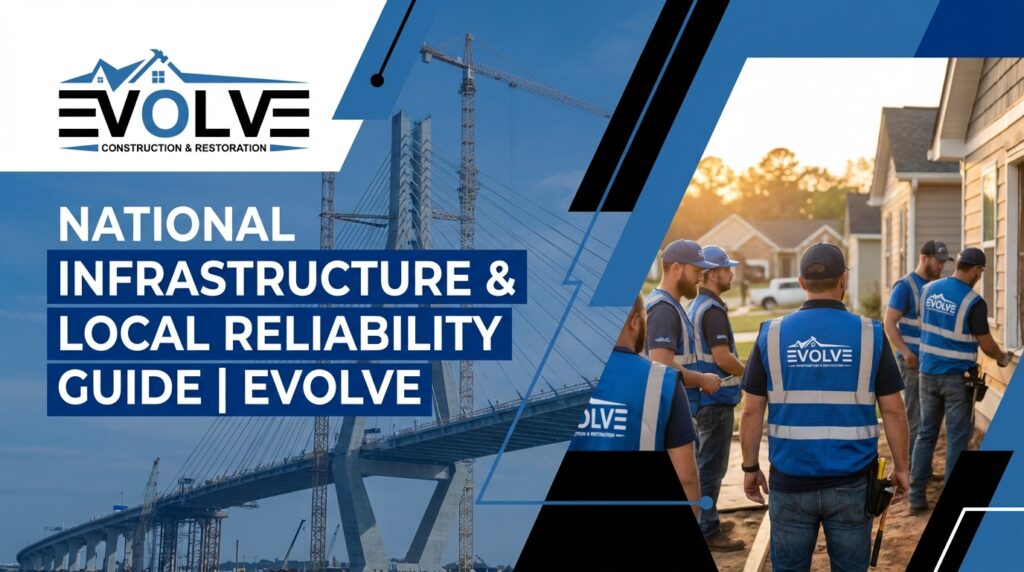
Here To Stay: How Our National Infrastructure Delivers Local Reliability
National infrastructure and local reliability are two sides of the same coin. When we flip a light switch or expect a roof to hold during a hurricane, we are relying on a massive, invisible network of resources that spans the entire country. For homeowners and business owners, the word “local” often feels like a synonym for “trustworthy,” while “national” can feel distant. However, in the world of construction and utility management, national scale is actually the greatest guarantor of local stability. By leveraging a 20+ state footprint, a national powerhouse provides the financial weight, supply chain priority, and logistical redundancy that a strictly local shop simply cannot match.
The primary question homeowners ask is: How does national infrastructure deliver local reliability? National infrastructure provides the foundational stability, redundant resources, and financial backing necessary to ensure that local services—whether it is power delivery or storm restoration—remain consistent even during regional crises. This large-scale framework prevents the “domino effect” where a single local failure leads to long-term community instability.
1. The Invisible Backbone: Defining the Connection Between National Strength and Local Life
To understand the impact of national infrastructure on your daily life, you must first recognize the interconnectedness of the systems we use. National strength is not just about federal budgets; it is about the physical and digital threads that tie a neighborhood in Florida to a resource hub in California. When local systems are backed by national networks, they gain a level of “borrowed strength.” This means that if a local resource is depleted—such as a shortage of roofing materials after a major hail storm—the national network can reroute supplies from unaffected regions to fill the gap.
This connection creates a safety net for the consumer. Many people fear the “out-of-state” label because they associate it with “fly-by-night” operations. However, a true national infrastructure, like the one maintained by Evolve Construction across 20+ states, transforms the definition of a contractor. Instead of a temporary presence, the national scale provides the permanent financial stability required to honor long-term commitments. A local company might go out of business after a single bad season, but a national powerhouse has the diversified revenue streams to stay standing for decades.
Furthermore, national infrastructure sets the standards for local execution. Organizations like the Federal Energy Regulatory Commission (FERC) and the North American Electric Reliability Corporation (NERC) create frameworks that ensure your local utility provider meets specific safety and uptime benchmarks. Similarly, a national construction firm brings standardized, high-level certifications—like the GAF Golden Pledge—to every local market they serve, ensuring that a homeowner in a small town receives the same elite quality as a skyscraper in a major city.
2. The Anatomy of Infrastructure: Mapping the Journey from Interstate Networks to Local Distribution
The physical journey of infrastructure is a complex handoff from “bulk” systems to “distribution” systems. In the energy sector, this is known as the transition from high-voltage interstate transmission lines to the lower-voltage lines that run down your street. This technical handoff occurs at substations, which act as the gatekeepers of local reliability. Without the massive capacity of the national grid, these local substations would have nothing to distribute. The national network provides the “N-1 Capacity,” a standard ensuring that if one major line fails, another is ready to take the load immediately.
In the construction and restoration industry, the “last mile” problem is equally critical. The last mile refers to the final step of delivering a service to the customer’s door. A company with a national footprint solves the last mile problem by maintaining local headquarters—from Sherman Oaks to Florida—while utilizing a centralized national logistics chain. This allows for the rapid deployment of specialized equipment and skilled labor that local markets often lack during times of peak demand, such as the aftermath of a hurricane or massive storm event.
The technical mechanics of this handoff are what prevent localized disasters from becoming permanent. For example, if a local water treatment plant loses power, its reliability depends on the national grid’s ability to reroute energy. If a homeowner’s roof is destroyed, their local reliability depends on their contractor’s ability to source materials from a national supply chain that isn’t throttled by local shortages. National infrastructure is the engine; local distribution is the wheels. You need both to move forward safely.
The Role of Redundancy and N-1 Standards
Redundancy is the hallmark of national infrastructure. The “N-1” standard is a planning philosophy where a system is designed to lose its largest single component and still function perfectly. When applied to national contracting, this means that even if one regional office is overwhelmed by a natural disaster, the surrounding offices can provide the administrative, financial, and labor support to ensure every customer’s warranty and project remains on track. This is the ultimate form of local reliability.
3. Reliability vs. Resilience: Why Keeping the Lights On Requires a Two-Tiered Strategy
While the terms are often used interchangeably, reliability and resilience are distinct concepts. Reliability is the ability of a system to perform its intended function under normal conditions (e.g., the roof doesn’t leak during a typical rainstorm). Resilience is the ability of a system to absorb a shock, recover quickly, and adapt to future challenges (e.g., how fast a contractor can repair your home after a Category 4 hurricane). National infrastructure is the primary driver of both, but it excels most in providing resilience.
A strictly local contractor may be reliable during sunny days, but they often lack the resilience required for major recovery efforts. We call these “storm chasers”—small operations that follow the wind but disappear when the hard work of long-term warranty support begins. In contrast, a national powerhouse builds resilience into its business model. Because they operate in 20+ states, they aren’t financially crippled by a disaster in one region. They have the “staying power” to be there five, ten, or twenty years later when you need to call in a warranty claim.
Take the GAF Golden Pledge Warranty as an example. This is the highest level of protection in the roofing industry, covering both materials and workmanship for decades. For a warranty like this to be meaningful, the company providing it must be “here to stay.” National infrastructure provides the financial assurance that the “local” face you see today is backed by a national entity that isn’t going anywhere. This is why national scale is the secret ingredient to true local reliability.
4. The Economic Engine: How National Infrastructure Fuels Local Job Growth and Business Stability
Infrastructure is the prerequisite for economic activity. Before a business can open its doors or a developer can build a housing complex, the national-to-local infrastructure must be verified. Reliable power, water, and transportation networks attract investment. When a community is known for its infrastructure stability, property values increase. This is the “Socioeconomic Impact of Utility Reliability.” If a grid is prone to failure, businesses leave, and property values plummet. Conversely, a robust national grid signals to the world that a local area is a safe place to invest capital.
On a more personal level, national companies create stable local jobs. While critics might argue that national firms “take money out of the community,” the reality is the opposite. A national firm like Evolve Construction invests in local economies by establishing permanent headquarters and hiring local tradespeople. These employees receive the benefit of national-level training, safety protocols, and benefits packages, which they then spend back in their own communities. This creates a virtuous cycle of economic growth fueled by national stability.
Furthermore, national infrastructure helps mitigate the “urban-rural divide.” Historically, rural areas have suffered from lower reliability because the cost of infrastructure per person is higher. However, national investment strategies—often supported by federal grants and large-scale private-public partnerships—ensure that even remote areas receive upgrades to their grids and services. By spreading the cost across a national footprint, the “powerhouse” can afford to bring elite services to communities that a smaller, local-only company might find unprofitable to serve.
5. Emerging Pressures: Navigating the Surge in AI, Data Centers, and Extreme Weather Events
We are currently witnessing an unprecedented surge in demand for infrastructure. The rise of Artificial Intelligence (AI) and the massive data centers required to power it are putting immense pressure on the national power grid. These data centers require massive amounts of energy 24/7, which can threaten the local reliability of nearby residential neighborhoods if the infrastructure isn’t properly managed. A national perspective is required to balance these “load growth drivers” so that innovation doesn’t come at the expense of the average homeowner’s comfort.
Simultaneously, the frequency of extreme weather events is testing the limits of our resilience. From “Atmospheric Rivers” in the West to record-breaking hurricanes in the East, the old standards of local reliability are no longer sufficient. We are now in an era where infrastructure must be “hardened” against climate threats. This requires significant capital investment—the kind of investment that only large, national entities can coordinate effectively. Whether it is burying power lines or installing solar shingles that can withstand high-velocity winds, the solutions are expensive and technically demanding.
Navigating these pressures requires a forward-looking strategy. Companies that operate on a national scale have a “birds-eye view” of these trends. They see the data centers being built in Virginia and the solar mandates in California, and they apply those lessons to their local operations in Florida or Texas. This cross-pollination of knowledge allows for a proactive rather than reactive approach to local reliability. By the time a new pressure reaches your neighborhood, a national powerhouse has likely already developed the solution in another market.
The Shift to Renewable Integration
As we move toward renewable energy, the national grid must become even more sophisticated. Wind and solar are often generated far from where they are used. National transmission lines are the only way to get green energy from a windy plain in the Midwest to a local home in a suburban metro area. This integration is vital for long-term reliability as fossil fuels become more volatile in price and availability.
6. The Interdependence Web: Why Water, Power, and Data Can No Longer Be Managed in Silos
One of the most critical lessons of modern infrastructure is “Sector Interdependence.” In the past, we treated the power grid, the water system, and telecommunications as completely separate entities. Today, we know that is a dangerous fallacy. If the power grid fails, water pumps stop working, and telecommunications towers go dark. If the data network goes down, utility companies lose the ability to monitor and manage the grid in real-time. This is why local reliability is a multifaceted challenge.
A national infrastructure approach recognizes these dependencies and creates “cross-sector” resilience. This means designing systems where a failure in one area doesn’t cause a total collapse in others. For example, the use of solar power with battery storage at the local level (residential solar) provides a backup for the national grid, while the national grid provides the stability for the solar system to function. This synergy is only possible when there is a high-level strategic coordination between national policy and local implementation.
Consider the “Colonial Pipeline” incident or the 2021 Texas power grid failure. These were national-scale failures that had devastating local consequences. They proved that no community is an island. To ensure your local reliability, you must be part of a robust, well-maintained national system. For contractors and service providers, this means offering a holistic suite of services—from roofing and solar to restoration and remodeling—to ensure that every aspect of the home’s protective shell is functioning in harmony with the larger environment.
7. Modernizing for Tomorrow: Strategic Investments in Grid Intelligence and Cybersecurity
The future of infrastructure is not just made of steel and concrete; it is made of silicon and code. Grid modernization involves the installation of “Smart Grid” technology that can detect a power outage before the customer even knows it happened. These sensors and automated switches can reroute power in milliseconds, significantly reducing the duration of local outages. This “Grid Intelligence” is the next frontier of reliability, and it is being driven by national-level research and development.
However, with increased connectivity comes increased risk. Cybersecurity is now a major pillar of national infrastructure. Protecting our local reliability means protecting the national servers from foreign or domestic bad actors who wish to disrupt our way of life. A company with national scale has the resources to invest in high-level cybersecurity protocols, protecting the sensitive data of their thousands of customers. This is a level of security that a small, local contractor simply cannot provide, often leaving customer data vulnerable on unencrypted local servers.
Investment in the future also means preparing for the rise of Electric Vehicles (EVs). As more homeowners switch to EVs, the local distribution of power will need to be upgraded to handle the new load. National infrastructure planning is currently underway to ensure that when you plug in your car at night, the lights in your house don’t flicker. This transition requires a massive, coordinated effort between federal regulators, state commissions, and local service providers—the ultimate example of the “national-to-local” pipeline in action.
8. Conclusion: Building a ‘Here to Stay’ Legacy — The Social Contract of Infrastructure Reliability
Ultimately, the relationship between national infrastructure and local reliability is a social contract. It is a promise that despite the chaos of extreme weather or shifting economic tides, the systems we depend on will remain standing. At Evolve Construction, we take this contract seriously. By maintaining a presence in over 20 states, from our headquarters in Sherman Oaks to our offices in Florida, we have built a national powerhouse designed specifically to deliver local peace of mind. We are not “out-of-state contractors”; we are a national infrastructure for home protection.
This national scale is what allows us to offer the GAF Golden Pledge and other industry-leading warranties with total confidence. We have the financial stability to honor our word decades after the job is done. We have the logistics to arrive first after a storm and the staying power to be the last ones to leave. When you choose a partner with national reach, you aren’t just getting a service; you are plugging into a network of reliability that is designed to protect your most valuable asset: your home.
In an era of uncertainty, reliability is the ultimate luxury. Whether it is the national grid keeping your lights on or Evolve Construction keeping your roof over your head, the principle remains the same: Scale equals stability. By understanding how national infrastructure delivers local reliability, you can make more informed decisions for your family and your business, choosing partners who are truly “Here to Stay.” Together, we can build a better, more resilient tomorrow, one community at a time.
Ready to Get Started?
Our honest, friendly, and reputable professionals help homeowners and businesses maximize the value of their property and stand together with them to rebuild for a better tomorrow, especially after challenging storm events.