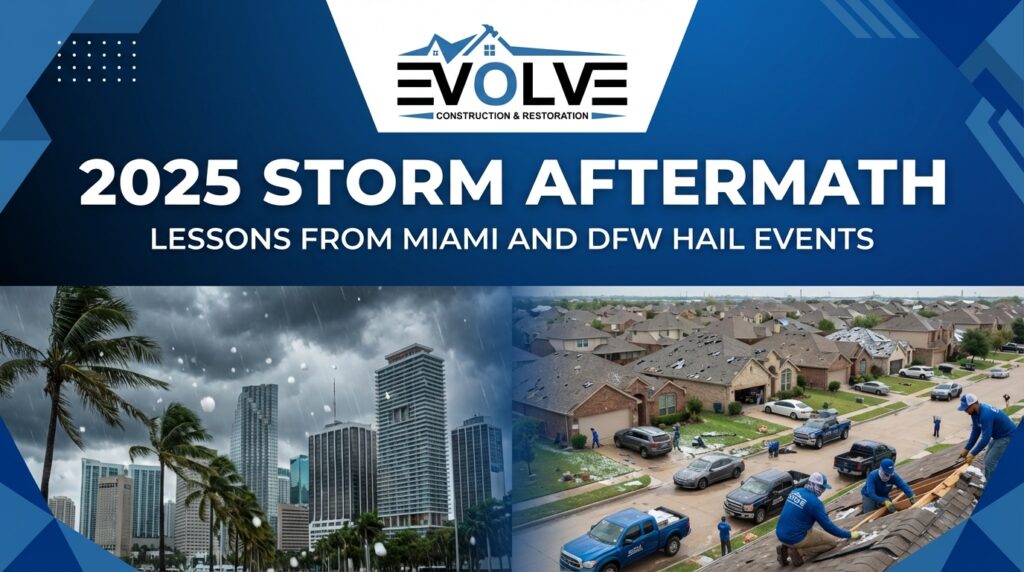
2025 Storm Aftermath: Lessons from Miami and DFW Hail Events
The 2025 storm season will be remembered as a pivotal moment in the history of North American property management and residential resilience. From the unexpected supercells over South Florida to the relentless triple-threat hail events across the Dallas-Fort Worth (DFW) metroplex, homeowners and insurers alike were forced to confront a new reality of extreme weather. These events were not merely routine storms; they were high-velocity, high-impact anomalies that tested the limits of modern building materials and the integrity of the restoration industry. As we analyze the 2025 storm aftermath, the lessons learned from Miami and DFW provide a roadmap for future preparedness, emphasizing the critical need for professional inspections and transparent documentation.
For residents in these regions, the path to recovery has been complicated by the sheer scale of the damage. In Miami, the May 5 event shattered perceptions that hail was a “Northern problem,” while DFW’s recurring hits in March, June, and September left communities in a state of constant repair. This comprehensive guide explores the meteorological drivers, the material failures, and the administrative innovations that have emerged from the wreckage. By understanding what went wrong and what held firm, property owners can better protect their investments against the increasingly volatile climate patterns forecasted for the years ahead.
Direct Answer: What are the main lessons from the 2025 hail events?
The 2025 Miami and DFW hail events highlighted that traditional building materials are increasingly vulnerable to wind-driven ice, early warning systems require urgent modernization, and digital security in claims—specifically verified electronic signatures—is essential to protect homeowners from predatory fraud during the restoration process.
1. The Unprecedented Hail Season of 2025 in Miami and DFW
The year 2025 defied historical averages for severe convective storms. While hail is a common occurrence in the central United States, the intensity and geographic spread seen this year were anomalous. The DFW metroplex, already a known hotspot for hail, experienced a “triple threat” of major events that saturated the local restoration market and left supply chains strained. Meanwhile, the South Florida event challenged the very engineering standards of a region primarily built to withstand horizontal hurricane winds rather than vertical hail impact. These events collectively caused billions in insured losses, prompting a re-evaluation of risk across the Sun Belt.
The Scale of Economic Impact
The financial toll of the 2025 storms was staggering. Initial reports from the Insurance Information Institute suggest that the combined losses from the Miami and DFW events exceeded $12 billion in residential property damage alone. This excludes the secondary costs associated with business interruptions and the rising cost of living due to insurance premium hikes. For homeowners, the aftermath was not just a matter of fixing a roof; it was a navigation of a complex economic landscape where labor was scarce and material costs were fluctuating daily. This economic volatility underscored the importance of working with established, reputable contractors who could guarantee pricing and timelines.
Geographic Vulnerability and the Urban Heat Island Effect
One emerging lesson from 2025 is how urban development influences storm severity. In both Miami and Dallas, the “urban heat island” effect appeared to exacerbate the intensity of supercells as they passed over densely populated areas. The concrete and asphalt of these metropolitan hubs retained heat, providing additional lift for the atmospheric moisture that fuels hail formation. This phenomenon resulted in larger hailstones falling directly over high-value real estate, magnifying the damage compared to previous storms that occurred over rural areas. Understanding this localized intensification is now a priority for urban planners and roofing professionals alike.
2. The Miami Anomaly: Analyzing the May 5 Supercell and its Impact on South Florida
On May 5, 2025, a rare and powerful supercell swept across Miami-Dade County, catching many residents off guard. Hail is statistically rare in South Florida due to the warm atmosphere, which usually melts falling ice before it reaches the ground. However, a deep layer of cold air in the upper atmosphere, combined with intense updrafts, allowed hailstones of up to 2.5 inches to bombard the region. Areas like Homestead, Coral Gables, and parts of downtown Miami saw significant impacts, marking this as the most destructive hail event in the region’s recorded history.
The Failure of Conventional Tropical Roofing
South Florida’s building codes are world-renowned for their hurricane resistance, focusing on uplift and pressure. However, the May 5 storm revealed a critical gap: impact resistance against large hail. Traditional clay and concrete tiles, while excellent for wind, proved brittle under the direct vertical force of 2.5-inch ice. Many homeowners discovered that while their roofs stayed attached during high winds, the tiles were shattered, leading to immediate water intrusion during the subsequent heavy rains. This event has sparked a renewed interest in impact-rated underlayments and reinforced tile systems that offer a more comprehensive shield.
Rapid Response and the Local Labor Gap
Because Miami is not a traditional “hail market,” the local restoration industry was initially unprepared for the volume of specialized hail damage claims. Many roofing companies that specialize in flat roofs or standard shingles lacked the equipment to handle mass tile replacement. This led to a surge in out-of-state “storm chasers” entering the market, many of whom lacked the necessary knowledge of Miami-Dade’s High-Velocity Hurricane Zone (HVHZ) requirements. The lesson for Miami residents was clear: in the wake of an anomaly, the value of a locally licensed contractor with deep knowledge of South Florida’s specific codes is irreplaceable.
3. North Texas’s Triple Threat: Chronology of the March, June, and September DFW Events
While Miami dealt with a single shock, the DFW metroplex suffered through a grueling cycle of destruction in 2025. The chronology began in March with a wind-driven hail event that predominantly affected Denton and Collin counties. This was followed by a massive June event characterized by hailstones exceeding 3 inches in diameter, and finally, a September storm that primarily targeted green infrastructure and solar installations. This repeated hammering meant that many homeowners were filing second or even third claims before the first repairs had even been completed, creating an administrative nightmare for the insurance claims assistance process.
The March Wind-Driven Hail Phenomenon
The March event was particularly insidious because the hail was accompanied by 70+ mph straight-line winds. This caused the ice to strike surfaces at an angle, damaging siding, windows, and soffits that are typically shielded by roof overhangs. In Denton, TX, the damage was exacerbated by a failure in the local emergency alert system, which left residents without enough time to move vehicles or secure property. This failure highlighted the need for redundant personal warning systems and professional damage assessments that look beyond the roof to the entire building envelope.
The June Giant Hail Event
June’s event brought “gorilla hail” to neighborhoods like Frisco and Plano. With stones larger than baseballs, even impact-resistant materials were tested to their breaking point. This event served as a case study for the limitations of standard asphalt shingles. Even brand-new roofs installed after the March storm were decimated if they were not upgraded to Class 4 Impact Resistant materials. The sheer energy of 3-inch hail falling from 30,000 feet is enough to penetrate decking, making prompt inspections vital to prevent structural water damage.
4. Comparative Damage Analysis: How Building Materials Fared (Tile vs. Asphalt vs. Metal)
One of the most valuable outcomes of the 2025 storm aftermath is the data gathered on material performance. By comparing how different roofing and siding materials handled the stress of 2025, homeowners can make more informed decisions during the restoration phase. The data suggests a clear hierarchy of resilience, with modern synthetics and high-grade metals outperforming traditional materials in almost every metric. However, the “best” material often depended on the specific nature of the storm—whether it was the sheer size of the hail in DFW or the high-velocity impacts in Miami.
Standard Asphalt
Poor
Granule loss, bruising, mat fracture
Upgrade to Class 4 IR
Concrete/Clay Tile
Moderate
Cracking and shattering
Use reinforced/thickened tiles
Stone-Coated Steel
Excellent
Cosmetic denting (rarely functional)
Best for long-term DFW resilience
Solar Shingles
Variable
Glass fracture in larger stones
Choose tempered, impact-rated units
The Vulnerability of Green Infrastructure
The September DFW event was a wake-up call for the solar industry. Residential solar panels, often touted for their durability, saw a high failure rate when faced with 2.5-inch wind-driven hail. Many systems that were installed without adequate impact ratings suffered micro-fractures that weren’t visible to the naked eye but significantly reduced energy output. For homeowners investing in solar power, the lesson is to prioritize systems with high-velocity hail certifications and ensure that their homeowners’ insurance policy specifically covers the replacement of these high-tech components.
Asphalt Shingles: The Class 4 Difference
In DFW, the difference between a total roof replacement and a simple repair often came down to the grade of shingle. Standard 3-tab and even basic architectural shingles were no match for the June storms. However, roofs equipped with Class 4 Impact Resistant (IR) shingles—which utilize polymer-modified asphalt for greater flexibility—showed remarkably fewer punctures. While the initial investment in Class 4 materials is higher, the 2025 events proved that the long-term savings in deductibles and insurance premiums make it the most logical choice for North Texas residents.
5. Meteorological Post-Mortem: ENSO, Gulf Moisture, and the Science of the 2025 Extremes
Why was 2025 so much worse than previous years? Meteorologists point to a perfect storm of atmospheric conditions. The transition into a Neutral ENSO (El Niño-Southern Oscillation) phase played a significant role. During neutral phases, the jet stream often becomes more volatile and “wavy,” allowing cold Canadian air to dip further south and collide with warm, moisture-rich air from the Gulf of Mexico. This collision is the fundamental engine for supercell development, and in 2025, the “dry line” in Texas and the sea-breeze fronts in Florida were unusually active.
Record Gulf Temperatures
The fuel for the 2025 storms was the record-high sea surface temperatures in the Gulf of Mexico. Warmer water leads to higher dew points and more atmospheric instability. In the Miami May 5 event, this moisture acted as a massive energy reservoir, allowing a standard afternoon thunderstorm to explode into a severe supercell within minutes. For North Texas, the Gulf moisture was funneled northward by a persistent low-pressure system, providing the necessary “lifting” mechanism for the massive hailstones seen in June. This trend of warming oceans suggests that the 2025 season may be a preview of the “new normal.”
The Jet Stream and Atmospheric Blocking
In 2025, atmospheric “blocking” patterns caused storms to stall over specific regions. Instead of moving quickly across the plains, the supercells over DFW in March and June lingered, dropping hail over the same neighborhoods for extended periods. This repeated bombardment is far more damaging than a fast-moving storm, as it compromises the structural integrity of roofing materials through cumulative stress. Understanding these larger climate drivers helps companies like Evolve Construction advise homeowners on the type of long-term protection necessary for their specific geography.
6. The 2025 Insurance Playbook: Navigating Claims in Volatile Markets
The insurance landscape in 2025 became a battlefield for many homeowners. In Florida, the market was already fragile following years of hurricane losses, and the May 5 hail event pushed several smaller carriers to the brink. In Texas, while the market remained more stable, premiums skyrocketed as carriers adjusted their risk models to account for the increasing frequency of “Act of God” events. Navigating this environment required a strategic approach to documentation and a deep understanding of policy language regarding depreciation and matching exclusions.
Florida’s Market Crisis and the Hail Impact
For Miami residents, the 2025 hail event was a double-edged sword. On one hand, it provided a clear path for roof replacement under “direct physical loss” coverage. On the other hand, the influx of claims led to longer processing times and more aggressive adjusters looking for reasons to deny or underpay claims. Many homeowners found that their policies included new “roof payment schedules” that significantly reduced the payout based on the age of the roof. This highlighted the absolute necessity of having a professional contractor present during the adjuster’s inspection to advocate for the homeowner’s best interests.
Texas Premiums and Deductible Management
In Texas, the 2025 aftermath led to a widespread shift toward percentage-based deductibles. Many homeowners who thought they had a flat $1,000 deductible realized they were actually responsible for 1% or 2% of their home’s insured value—often totaling $5,000 to $10,000. This financial shock made the accuracy of the claim estimate even more critical. Homeowners learned that they couldn’t afford to leave money on the table; ensuring that every dented gutter, cracked window screen, and bruised shingle was accounted for became the difference between a successful restoration and an out-of-pocket disaster.
7. Lessons in Technology: Early Warning Systems, AI Damage Scans, and Notification Failures
One of the most significant advancements—and failures—seen in 2025 involved technology. While early warning systems failed residents in Denton during the March event, new technologies in damage assessment provided unprecedented accuracy for those filing claims. AI-driven drone scans and high-resolution satellite imagery allowed for the detection of “bruising” on asphalt shingles that traditional human inspections might have missed. However, the most critical technological lesson involved the security of the homeowners themselves during the administrative phase of their recovery.
The Security Spin: Protecting Homeowners with Digital Platforms
In the chaotic aftermath of the 2025 storms, a terrifying trend emerged: consumer complaints regarding forged signatures on physical letters of representation and unauthorized endorsements on physical insurance checks. To combat this, reputable firms like Evolve Construction have pivoted to state-of-the-art digital security measures designed specifically to protect the homeowner. The use of digital platforms like DocuSign is no longer just a convenience; it is a primary safety measure. These platforms provide a verified, trackable digital agreement with an unalterable paper trail, including IP addresses and time stamps.
Why Trackable Digital Agreements Matter
By moving away from paper documents that can be easily manipulated or misplaced, homeowners retain absolute control over their claims process. A digital audit trail guarantees that every signature is legitimate and that every change to a contract is documented and approved by the property owner. This transparency eliminates the risk of “ghost contractors” or unauthorized third parties interfering with insurance funds. In the 2025 storm aftermath, homeowners who utilized these verified digital systems experienced significantly fewer legal hurdles and enjoyed a much faster path to project completion.
8. Future-Proofing Infrastructure: Policy Recommendations and Resilience Strategies for 2026
The lessons of 2025 must be translated into action for 2026 and beyond. This involves both individual property owner decisions and broader policy changes at the municipal level. For DFW, the priority is the adoption of mandatory Class 4 impact resistance for all new residential construction. For Miami-Dade, the integration of hail-impact standards into the existing High-Velocity Hurricane Zone (HVHZ) codes is a necessary step to address the changing climate reality. Beyond codes, the 2025 season taught us that infrastructure resilience is also about the “soft” systems we use to manage restoration.
Adopting the “Fortified Home” Standard
Many homeowners are now looking toward the “FORTIFIED Home™” designation, a set of engineering and installation standards designed to strengthen homes against severe weather. This includes enhanced roof deck attachment, sealed roof decks to prevent water intrusion even if the primary covering is lost, and impact-resistant materials. Properties that met these standards in 2025 saw significantly less interior damage, even when the hail was large enough to damage the outer roof layer. Investing in these standards is increasingly seen not just as a safety measure, but as a way to preserve property value in a volatile market.
Labor Market Resilience and Licensing
The simultaneous major events in Miami and DFW created a massive strain on the availability of licensed roofing contractors. In 2025, wait times for repairs stretched to six months in some areas. This labor constraint emphasizes the importance of maintaining a relationship with a large, reputable construction firm that has the scale to manage multiple major events. Homeowners are encouraged to verify licenses and insurance early, avoiding the rush of “storm chasers” who often vanish when the next major event occurs in another state. Building a community of trusted local professionals is a key component of regional resilience.
9. Conclusion: Building a Culture of Preparedness in the New Climate Reality
The 2025 storm aftermath serves as a powerful reminder that we are entering a new era of environmental challenges. The lessons from Miami’s rare supercell and DFW’s recurring hail events teach us that the old ways of thinking about property protection are no longer sufficient. We must embrace better materials, more sophisticated technology, and higher standards of transparency to safeguard our homes and businesses. Whether it’s upgrading to impact-resistant shingles or insisting on verified digital contracts to prevent fraud, every proactive step taken today is an investment in a more secure tomorrow.
At Evolve Construction, we remain committed to standing with our communities through these challenging times. We don’t just repair roofs; we help homeowners rebuild their lives with confidence and clarity. By applying the lessons of 2025, we can work together to ensure that the next storm season finds us stronger, smarter, and better prepared than ever before. Remember, the best time to prepare for a storm is before the first cloud appears on the horizon, but the second-best time is right now, using the hard-won wisdom of the past year.
Ready to Get Started?
Our honest, friendly, and reputable professionals help homeowners and businesses maximize the value of their property and stand together with them to rebuild for a better tomorrow, especially after challenging storm events.